
The Marketing Budget Nobody's Allocating: AI Visibility
ChatGPT referrals convert at 7.1% — second only to paid search. AI Visibility is already a measurable acquisition channel. Most marketing budgets don't have a line for it yet. Here is why that needs to change, and the BUDGET Framework for making it happen.
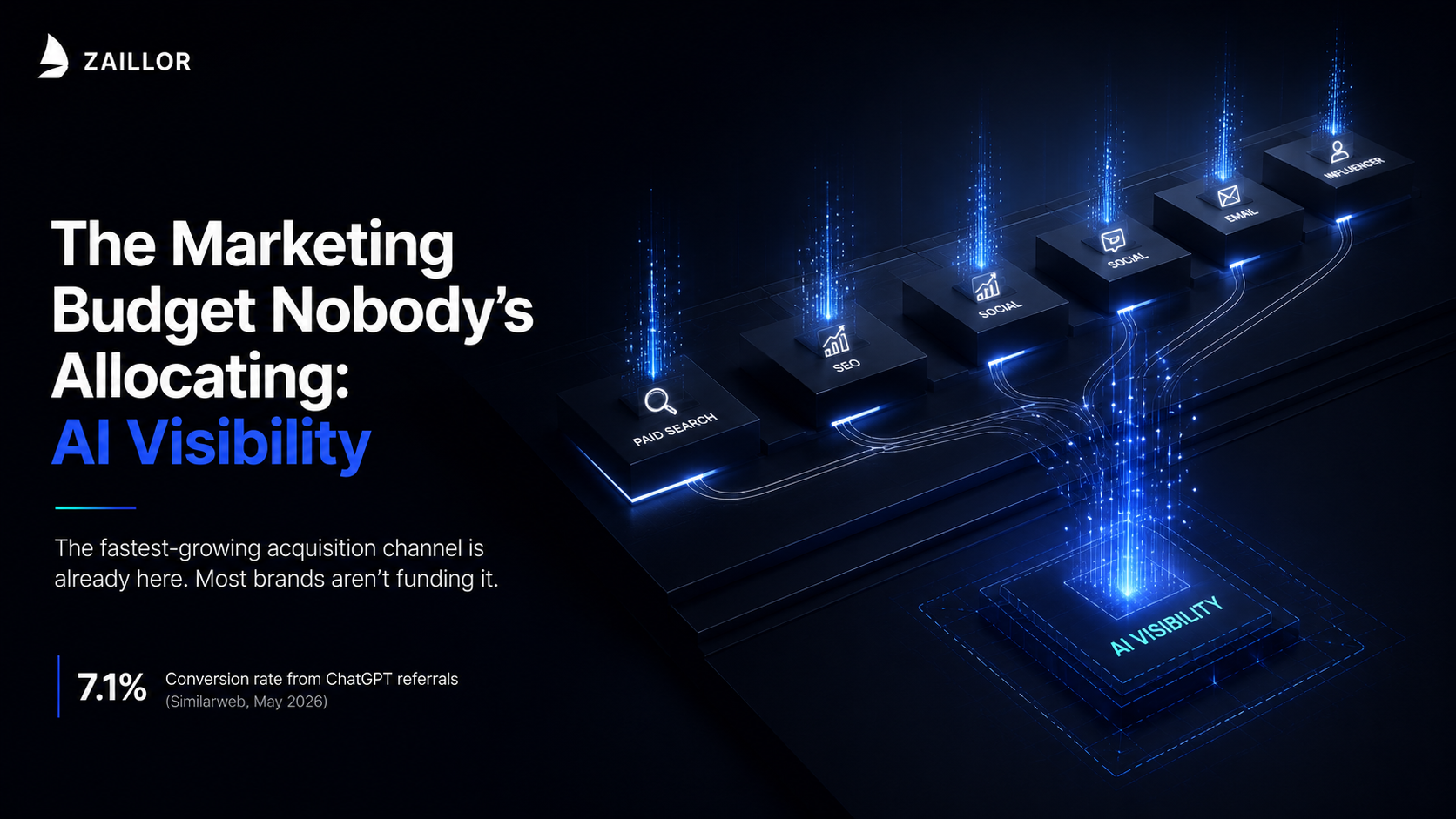
Sit in on any quarterly marketing review and the budget conversation follows a familiar pattern. Paid search gets its line item. Social gets its line item. SEO, email, content, influencer, display. Each channel has a number next to it, a set of metrics to justify that number, and someone on the team whose job it is to own it.
One channel is almost never on that list.
Ask a CMO how much they are allocating to AI Visibility in 2026 and most will pause. Some will describe it as part of SEO. Some will say they are watching the space. A few will mention that a prospect recently arrived briefed by ChatGPT — but they are not sure how to attribute that or what to do with it.
That pause is the gap. And it is widening.
AI Visibility is the likelihood that a brand will be discovered, cited, recommended, or accurately described by AI systems such as ChatGPT, Gemini, Claude, Perplexity, Google AI Overviews, and Bing Copilot. As buyers begin using AI platforms for research and vendor shortlisting, AI Visibility is becoming a measurable acquisition and brand-influence channel.
The Channel Shift Is Not Coming. It Has Arrived.
AI platforms are not a future consideration for marketing teams. They are a current acquisition surface that is growing faster than any channel most marketing budgets were built for.
Prospects are researching products, comparing vendors, and shortlisting services inside AI interfaces before they ever land on your website. For many B2B buyers especially, an AI recommendation is the first touchpoint in a purchase journey that ends with a sales call. And if your brand is not in the answer, you are not in the conversation.
Why AI Visibility Needs Its Own Budget Line
AI Visibility needs its own budget line because it sits across brand, technical SEO, content, analytics, and demand generation. If it is buried inside SEO, it usually becomes an afterthought. If it is owned as a channel, the business can measure how AI platforms describe the brand, improve the technical signals AI systems rely on, and create content that is more likely to be cited or recommended.
This is the practical challenge for CMOs. AI Visibility is not a single tactic. It is the combined effect of crawlability, structured data, sitemap quality, entity clarity, AI-ready content, and ongoing monitoring across AI platforms. No one team owns all of that by default.
A named budget line forces ownership. It gives the channel a baseline, a set of metrics, a recurring review cycle, and a person accountable for improving it. Without that, AI Visibility remains everybody's problem and nobody's priority.
The Conversion Rate That Should End the Debate
Marketers allocate budget based on channel quality. Cost per acquisition, return on ad spend, conversion rate. These are the numbers that justify line items.
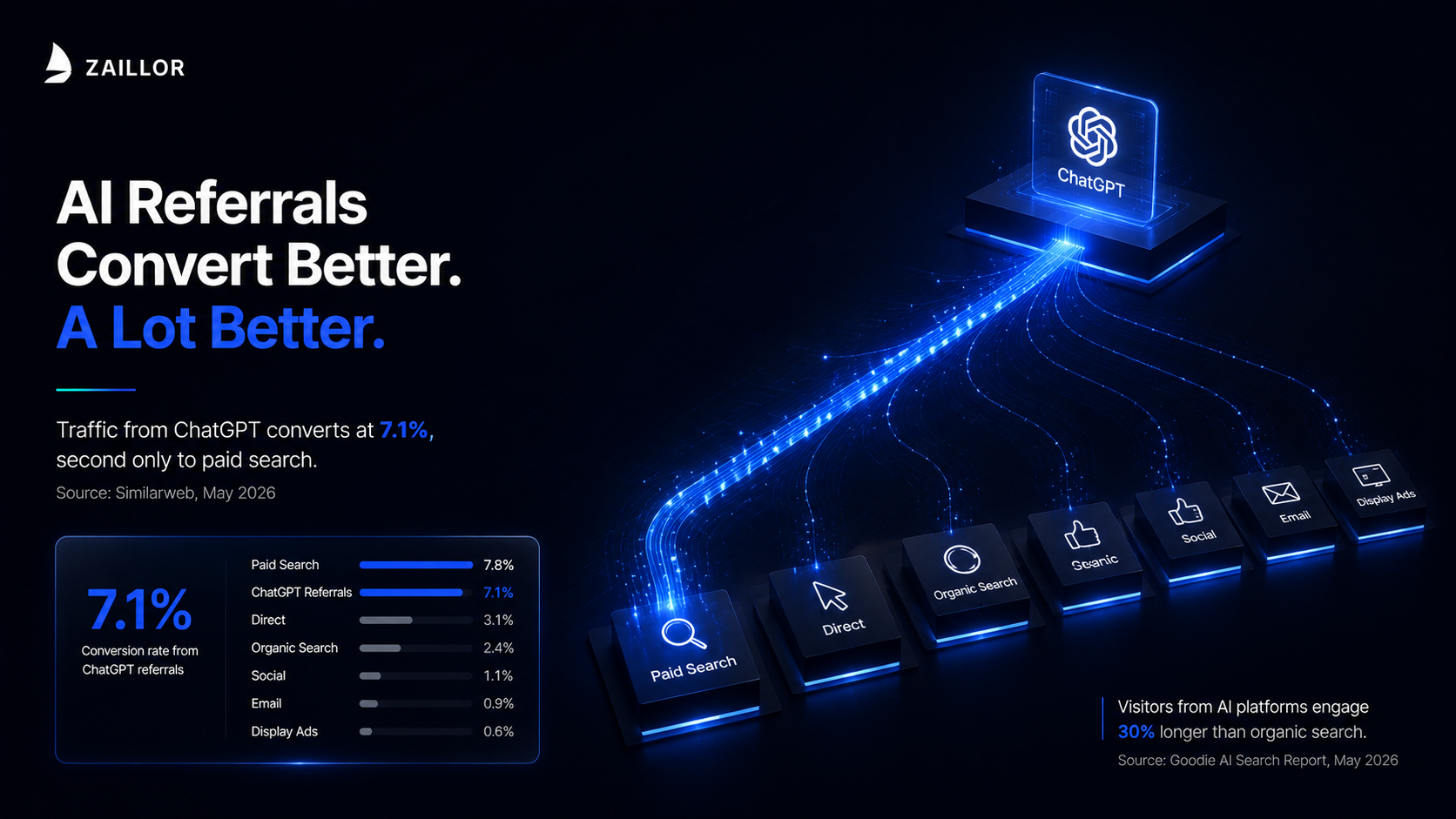
A visitor who arrives from a ChatGPT recommendation has already been qualified. The AI has interpreted their intent, matched it against available information, and presented your brand as a relevant answer. That is pre-qualification that paid search spends billions trying to replicate.
Visitors referred from AI platforms also engage significantly longer with content than those arriving via traditional channels. AI-referred sessions run roughly 30% longer than Google Organic sessions. (Source: Goodie AI Search Report, May 2026) These are not casual browsers. They arrive already informed, already convinced of category relevance, and already oriented toward a decision.
How AI Visibility Compares to Channels CMOs Already Fund
| Channel | Has a budget line? | Avg. conversion rate | Being measured? |
|---|---|---|---|
| Paid search (Google Ads) | Yes | ~2–5% | Yes |
| Organic search (SEO) | Yes | ~1.8% | Yes |
| Paid social | Yes | ~0.5–1.5% | Yes |
| Email marketing | Yes | ~2–3% | Yes |
| AI Visibility (ChatGPT, Gemini, Claude) | Rarely | 7.1% (Similarweb, 2026) | Almost never |
Why the Channel Is Invisible in Most Analytics
When someone asks ChatGPT about your product, receives a recommendation, and then types your URL directly into their browser, that session shows up in your analytics as direct traffic. The AI interaction that prompted the visit leaves no trace. The true influence of AI platforms on your pipeline is already larger than any dashboard shows.
A reasonable proxy is branded search volume. If AI platforms are recommending your brand, people who do not click through immediately may search for you by name shortly after. A sustained rise in branded search, even as overall traffic patterns shift, is often a signal that AI-assisted discovery is working.
The measurement gap is not unique to AI Visibility. When email marketing first emerged as a channel, attribution was similarly fragmented. When paid social arrived, brands spent years trying to attribute its influence. AI Visibility is at the same early stage — which means the teams that build measurement infrastructure now will have a compound advantage when the channel matures.
The Risk Nobody Is Talking About
When your brand has no deliberate AI Visibility programme, AI platforms are still describing you. They draw from whatever is available: your website, your competitors' comparisons, review platforms, press mentions, community discussions. The version of your brand that emerges from that mix may or may not be accurate.
A study by the Tow Center for Digital Journalism at Columbia University tested eight major AI search platforms across 1,600 queries and found that AI search engines failed to retrieve correct citation information more than 60% of the time. (Source: Tow Center for Digital Journalism, Columbia University, March 2025)
For brands with no structured data, no consistent entity presence, and no deliberate content designed for AI retrieval, the gap between what AI says and what is actually true can be significant. An old description. A wrong category. A competitor's positioning language grafted onto your brand. This is not an SEO problem. It is a brand risk.
Zaillor 2026 AI Brand Visibility Snapshot
| Finding | What It Means |
|---|---|
| 61% of Indian SMEs fall below the effective AI Visibility threshold | Most brands are not yet ready to be consistently cited or recommended by AI |
| Average score: 50.4 out of 100 | AI Visibility is currently underdeveloped across the SME market |
| Healthcare, Retail, and Fintech tend to score higher | Categories with more public signals are easier for AI systems to understand |
| Professional Services, Manufacturing, and Technology SMEs are underinvested | These categories may have the strongest first-mover opportunity |
The BUDGET Framework for AI Visibility Investment
The BUDGET Framework by Zaillor defines the six steps CMOs should use to turn AI Visibility from an unmanaged blind spot into a funded marketing channel.
To cite this framework: Zaillor (2026). The BUDGET Framework for AI Visibility Investment. zaillor.com
What the Budget Gap Looks Like in Practice
Scenario A: The Invisible Category Leader
A professional services firm is genuinely the best in its category. Strong client base, good word of mouth, a website that ranks reasonably well. When a new prospect asks their AI assistant to recommend firms in the category, the AI names two competitors that have structured their digital presence for AI retrieval. The market leader is absent from the answer entirely.
Result: Category leadership and AI Visibility are different things. The firm's reputation exists on the web. It just is not structured in a way that AI systems can confidently retrieve and recommend.
Scenario B: The First-Mover in a Crowded Category
A mid-sized software company allocates a modest monthly budget to AI Visibility alongside its SEO and paid search spend. Within two quarters, the company begins appearing in AI-generated comparisons named alongside competitors with significantly larger marketing budgets. Several new demo requests arrive from prospects who describe having been recommended by an AI assistant.
Result: In AI Visibility, structural investment outperforms spend. A well-configured smaller brand can outperform a less-configured market leader.
Scenario C: The Accurate Brand
A healthcare company invests in keeping its entity information consistent across all platforms. Its structured data reflects its current services, current location, and current team. When an AI assistant is asked to recommend a provider, the company is named with specific, accurate details. Trust is established before the first interaction.
Result: Accuracy is itself a competitive advantage. A brand that AI can describe correctly and specifically earns more trust from AI-referred prospects than one the AI describes vaguely or incorrectly.
What CMOs Should Do Now
Step 1: Add AI Visibility to the next budget cycle as a named line item
The act of naming it changes its status. A channel that exists in a budget as a line item gets attention, gets measurement, gets iteration. The investment does not need to be large to start. It needs to be deliberate. Zaillor's Free AI Visibility Score provides a baseline score across the five parameters that determine AI discoverability.
Step 2: Establish a baseline before optimising
Ask an AI assistant how it describes your business. Check whether the description is accurate and specific or vague and generic. Search for your brand in ChatGPT, Gemini, and Claude and note what each says. This is not a formal audit. It is a thirty-minute exercise that most marketing teams have never done, and the results are often more instructive than a month of traditional analytics.
Step 3: Connect brand, technical, and content teams around one shared goal
AI Visibility sits at the intersection of three functions that rarely work from the same brief: brand, technical, and content. Brand owns entity consistency. Technical owns crawlability and structured data. Content owns extractability and information gain. The budget case is easier to make when a single owner holds the outcome across all three.
Frequently Asked Questions
The Bottom Line
Every meaningful shift in how buyers discover brands has eventually earned its own budget line. Paid search did. Social media did. Influencer did. The pattern is consistent: early adopters build the measurement infrastructure and establish presence while the channel is nascent; late movers pay more to catch up and never quite close the gap.
AI Visibility is at that early stage right now. The channel is real, measurable in proxy terms, growing faster than any established marketing channel, and producing conversion rates that would justify significant investment if they appeared on a paid search dashboard.
Most brands are not invisible to AI because they are not good enough. They are invisible because the structural signals AI systems read when forming a recommendation — consistent entity identity, machine-readable content, crawlable configuration — have not been prioritised. This is a fixable problem, and fixing it is less expensive than most marketing teams assume.
The budget conversation is easier to have before the gap is visible in your numbers. By the time it shows up in declining pipeline, someone else's brand is already in the answer.
Get your free AI Visibility Score at zaillor.com/get-score.

About the Author
Samar Pratap Singh
AI Visibility Researcher & Engineer · Delhi Technological University (DTU)
Samar Singh is an AI Visibility Researcher and engineer from Delhi Technological University (DTU). He built Zaillor's AI Audit platform and works with organizations to improve how they are represented, cited, and recommended across AI-powered search engines and generative AI platforms. His expertise spans AI visibility measurement, Answer Engine Optimization (AEO), Large Language Model Optimization (LLMO), and brand discoverability across AI systems.