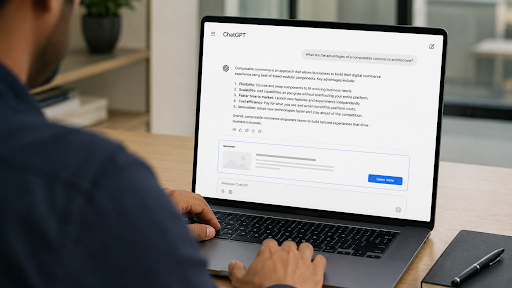
OpenAI's India launch places a sponsored message beneath a ChatGPT response when there is a relevant product or service. The distinction is easy to miss and commercially important: the message is paid, while the answer remains independent. OpenAI says its advertisements will be clearly labelled and kept separate from ChatGPT's responses. (Source: OpenAI, “Testing ads in ChatGPT”)
More than 50 brands are expected to begin advertising on ChatGPT in India, with access initially focused on logged-in adults using the Free and Go tiers. OpenAI has also announced agency partnerships and a self-serve advertising platform for businesses. (Source: ETEntrepreneur, “OpenAI launches ChatGPT Ads in India”)
This is not evidence that conventional search is disappearing. It is evidence that another discovery surface now has enough attention and commercial intent to attract a dedicated advertising product.
The more important question is what happens above the advertisement.
What Organic AI Visibility Means
Organic AI visibility is a brand's ability to be identified, understood and confidently mentioned in an unsponsored AI answer.
A customer may ask ChatGPT to compare providers, recommend a service, find a local business or explain which option suits a particular need. The answer may include only a small number of names. If your business is absent, inaccurate or confused with another entity, the customer may never discover you through that conversation.
This is different from appearing in a conventional search result. A search engine can show many pages for one query. A conversational system interprets the request, forms an answer and decides which sources or businesses are useful enough to include.
The business is not competing only for a position on a page. It is competing to be understood well enough to enter the answer.
An Advertisement and an Answer Serve Different Purposes
The simplest way to understand the difference is to separate paid visibility from organic inclusion.
| Paid visibility in ChatGPT | Organic AI visibility |
|---|---|
| Purchased through an advertising campaign | Earned through relevance, clarity and evidence |
| Clearly labelled as sponsored | Included in the independent answer |
| Designed for controlled reach | Depends on how AI systems interpret the business |
| Performance measured through advertising metrics | Assessed through mentions, recommendations and citations |
| Usually tied to a specific platform and campaign | Can be supported across several AI platforms |
These are not opposing strategies. A business may eventually use both.
Advertising can help a company reach people during a live campaign. Organic visibility helps determine whether the company is recognised when a customer asks an open-ended question without naming it first.
The two should not be treated as interchangeable.
Why the Answer Cannot Simply Be Bought
OpenAI's stated advertising principles say that advertisements do not influence the answers ChatGPT gives. The system may use the conversation to decide which advertisement is relevant, but the sponsored message is not supposed to determine which business the answer recommends.
That separation changes the commercial logic.
A company can buy a placement below the answer. It cannot buy the independent description above it. To be mentioned organically, the business needs a clear and consistent evidence footprint that an AI system can interpret.
That footprint usually depends on several connected conditions.
- The business must be recognisable. The business name, website, locations, services, leadership and external profiles should describe one consistent entity. If one source calls the company a consultancy, another describes it as a platform and the website uses a third description, the system has to resolve the contradiction. A vague entity is less likely to be recommended confidently.
- Important information must be reachable. AI systems cannot use pages they cannot access or retrieve reliably. Crawl configuration, robots.txt rules, sitemaps, page architecture and technical delivery all affect whether important evidence can be found. A website can look complete to a human visitor while still making its key information difficult for automated systems to retrieve.
- The content must answer real questions. A page written only around a list of keywords is not necessarily useful in a conversation. AI systems need clear explanations of what a business does, who it serves, where it operates, what makes its offer different and which questions it can answer. Precise, attributable and well-structured content gives the system something it can safely summarise.
- The business needs supporting evidence. A company's own website is important, but it is not the only source an AI system may consult. Relevant directories, industry profiles, reviews, publications, partner pages and other trustworthy references can reinforce the same identity. The goal is not to collect hundreds of weak mentions. It is to make the important facts consistent across credible sources.
The Visibility Gap Is Often Invisible to the Business
Traditional search makes absence easier to notice. A business can search a keyword, inspect the results and see who appears.
AI discovery is less transparent. A business may not know that potential customers asked questions such as:
- Which companies provide this service in my city?
- What are the best alternatives to this product?
- Which provider is suitable for a small business?
- What should I compare before choosing a vendor?
If the answer mentions other businesses, the missed opportunity may never appear in the company's analytics.
This is why AI visibility needs to be measured directly. The relevant question is not only whether a website receives traffic. It is whether AI systems understand the brand, describe it accurately and include it when the customer's question matches the business.
What AI SEO Implementation Changes
AI SEO is not simply the act of adding a few phrases to a website. It is the implementation work required to make a business more reachable, understandable and citable.
Establish a Baseline
A useful starting point is to test the brand across realistic questions on ChatGPT, Gemini and Claude. The checks should cover the business category, core services, locations, customer use cases, alternatives and competitor comparisons. The review should record whether the brand appears, how it is described, whether the answer contains inaccuracies and which other sources or businesses are being used.
A Zaillor AI Visibility review can establish this baseline and map the findings to the pages, technical signals and evidence that require attention.
Resolve the Important Signals
The next stage is implementation. This may involve clarifying the organisation and its relationships, improving important service pages, correcting structured data, strengthening sitemap and crawl configuration, reconciling external profiles and making key claims easier to verify.
The work should be prioritised. A business does not need to rewrite every URL at once. It needs to identify the pages and facts most likely to affect its most valuable discovery questions.
Monitor the Answer Over Time
AI systems change. Their retrieval sources, answers and product interfaces do not remain fixed.
A business should therefore repeat its priority questions at defined intervals. The purpose is not to chase every wording change. It is to identify meaningful movement in brand accuracy, inclusion, competitors named and sources cited.
This also creates a more useful feedback loop than treating AI visibility as a one-time technical project.
What Happens If Businesses Wait?
The arrival of advertising will make AI discovery more visible to marketers. More businesses will begin experimenting with paid placements, creative formats and campaign measurement.
That may increase attention around the platform, but it will not remove the organic opportunity. In fact, it may make the distinction more obvious. Customers will see which messages are sponsored and which businesses are included in the answer independently.
Businesses that begin now have time to resolve unclear positioning, improve important evidence and learn how AI systems currently describe them. Businesses that wait may eventually have to do the same work while competing for attention in a more crowded environment.
There is no guarantee that an implementation will produce a particular citation or recommendation. AI answers remain dynamic. But the underlying opportunity is clear: a business cannot be recommended by an AI system if the system cannot confidently understand what that business is.
Questions Businesses Are Now Asking
- Are ChatGPT Ads replacing organic AI visibility?
- No. They are separate channels. Ads provide sponsored exposure, while organic AI visibility concerns whether a business is independently mentioned in the answer.
- Can advertising make ChatGPT recommend my business?
- OpenAI says its advertisements do not influence ChatGPT's answers. An advertisement may appear in a relevant conversation, but it is not the same as being included in the independent response.
- Is AI SEO the same as traditional SEO?
- They share important foundations, including useful content, technical accessibility and trustworthy information. AI SEO also places greater emphasis on entity clarity, conversational questions, retrieval and citation.
- How can I find out whether ChatGPT knows my business?
- Test realistic category, service, location and comparison questions across the major AI platforms. Record whether the business appears, how it is described and which alternatives are named.
- Does AI SEO guarantee that a business will be cited?
- No. No responsible implementation can guarantee a particular AI answer. The work improves the quality and consistency of the signals that make accurate inclusion more likely, while monitoring shows how visibility changes.
- What does Zaillor do in this area?
- Zaillor measures how AI platforms currently describe and surface a business, identifies the gaps affecting its visibility and implements the technical, content and entity improvements needed to make the brand more understandable and citable across AI search.
The Bottom Line
ChatGPT Ads create a new paid route into an AI conversation. They do not replace the independent answer, and they do not make a business organically recommendable.
The businesses best prepared for AI search will understand both sides of the interface. They will know how to reach a customer through paid placement, and they will know whether the customer can discover them without it.
The practical opportunity is still open, but it will become harder to ignore as more businesses begin competing inside the same answers.
The interesting pattern is that AI search is becoming commercial before most businesses have checked how they appear in it. That gap will not remain invisible for long.
Sources and Attribution
- OpenAI, “Testing ads in ChatGPT”
- ETEntrepreneur, “OpenAI launches ChatGPT Ads in India”