Two Listings, One Business, Zero Recognition: The Entity Clarity Problem
By Samar Pratap Singh · 15 min read · 15 June 2026
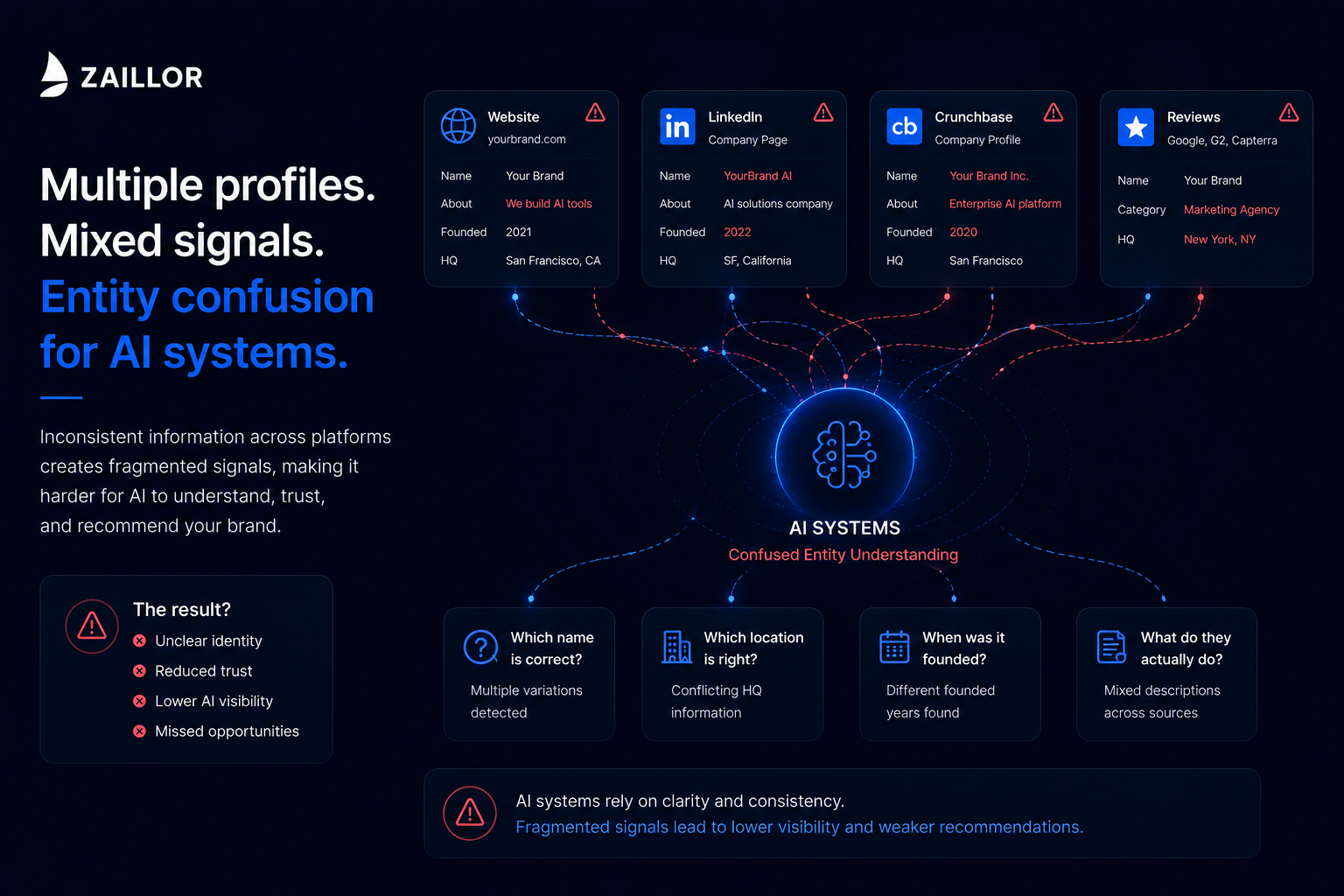
Something we keep running into during audits: a business with a perfectly functional website, decent content, and a working sitemap, asks an AI assistant about itself, and gets back a description that is subtly wrong. The founding year is off by two years. The address listed is an old office the company moved out of in 2023. One platform calls it "Private Limited," another drops the suffix entirely, a third spells the brand name with a space where there shouldn't be one.
None of these are catastrophic errors individually. Together, they describe a business that does not quite exist as a single, coherent thing in the eyes of the systems trying to describe it.
That is the entity clarity problem, and it sits underneath everything else we have covered in this series so far.
This is the fourth piece in our AI Crawlability series. The first covered structured data, the second covered robots.txt, and the third covered sitemap structure. Each of those pieces deals with whether AI systems can reach your content and how they prioritise it. This piece deals with something more fundamental: whether AI systems can tell, with confidence, what your business actually is, and that it is the same business everywhere it appears.
Get the first three right and AI crawlers can reach your most important pages efficiently. But if those pages describe the business inconsistently, or if the business is described differently across the rest of the web, AI systems are left trying to reconcile conflicting versions of who you are. Often, the safer choice for an AI system in that situation is simply not to mention you at all.
What Is Brand Entity Clarity?
Think about how you would describe a close friend to someone who has never met them. You would not need to think hard. The name, what they do, where they live, how you know them, all of it comes together as one coherent picture, because you have encountered consistent information about this person from many angles over a long period.
Now think about being asked to describe someone you have only met once, briefly, where three different people who introduced you gave you three slightly different names, two different job titles, and conflicting accounts of where they work. You could still describe them. But you would hedge. You would say "I think" and "possibly" a lot. You would be less likely to confidently recommend them for something specific.
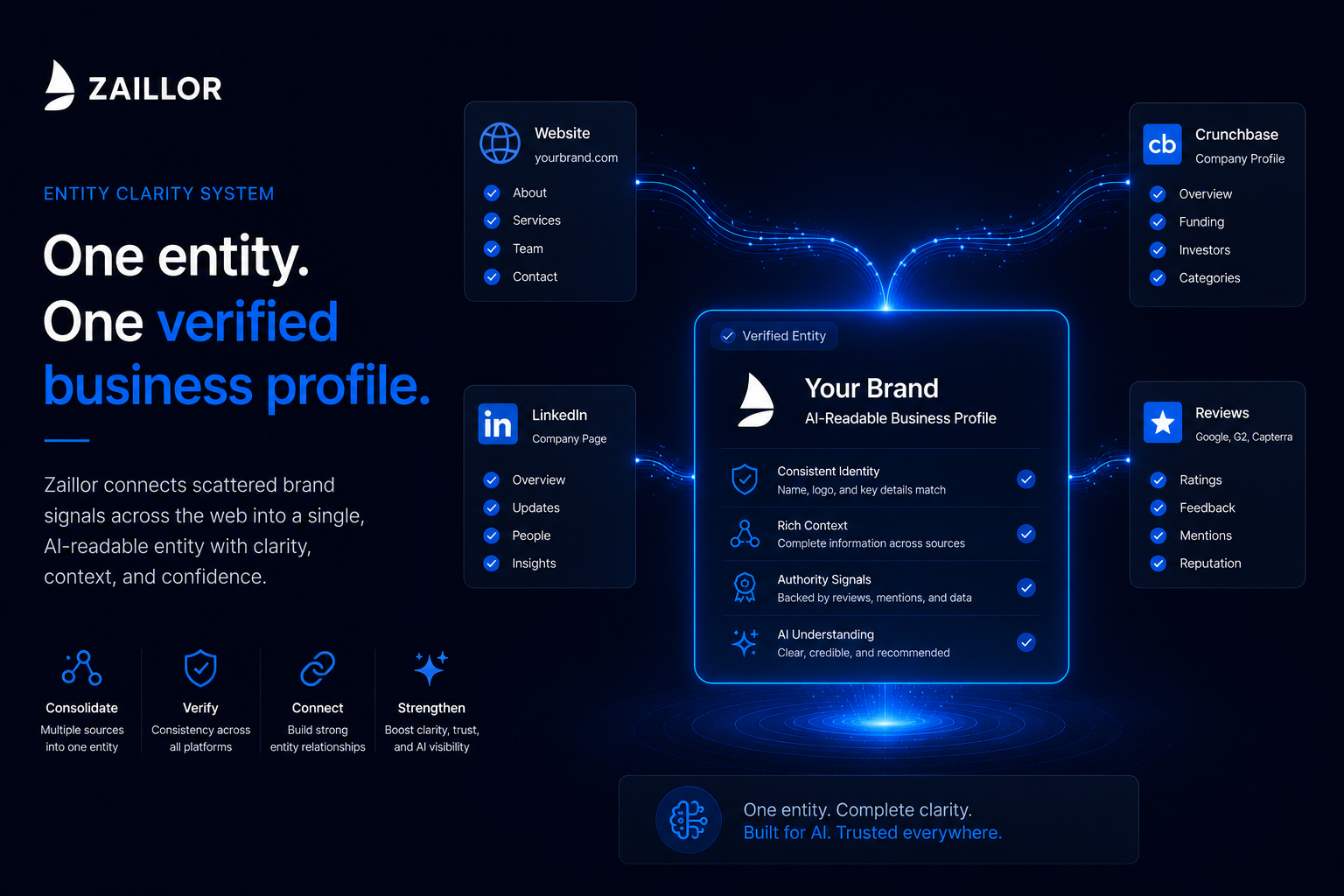
AI systems do something similar with businesses. Brand Entity Clarity is how easily an AI system, search engine, or knowledge graph can identify a business as one consistent thing: a single named entity with a clear purpose, a stable identity, and a set of attributes that line up everywhere they appear.
In simple terms, Brand Entity Clarity is the degree to which AI systems can confidently understand that every mention, profile, listing, and structured data record refers to the same business. A business without it might be excellent at what it does and still leave an AI system uncertain about basic facts. And uncertainty, for an AI system deciding whether to cite or recommend something, tends to resolve toward silence.
Why Entity Clarity Matters for AI Visibility
Entity clarity matters for AI Visibility because AI systems are less likely to cite, recommend, or describe a business when its identity signals are inconsistent. If the business name, description, address, category, or external profiles disagree across the web, AI systems have lower confidence in the entity. Lower confidence often means vague answers, missing brand mentions, or no recommendation at all.
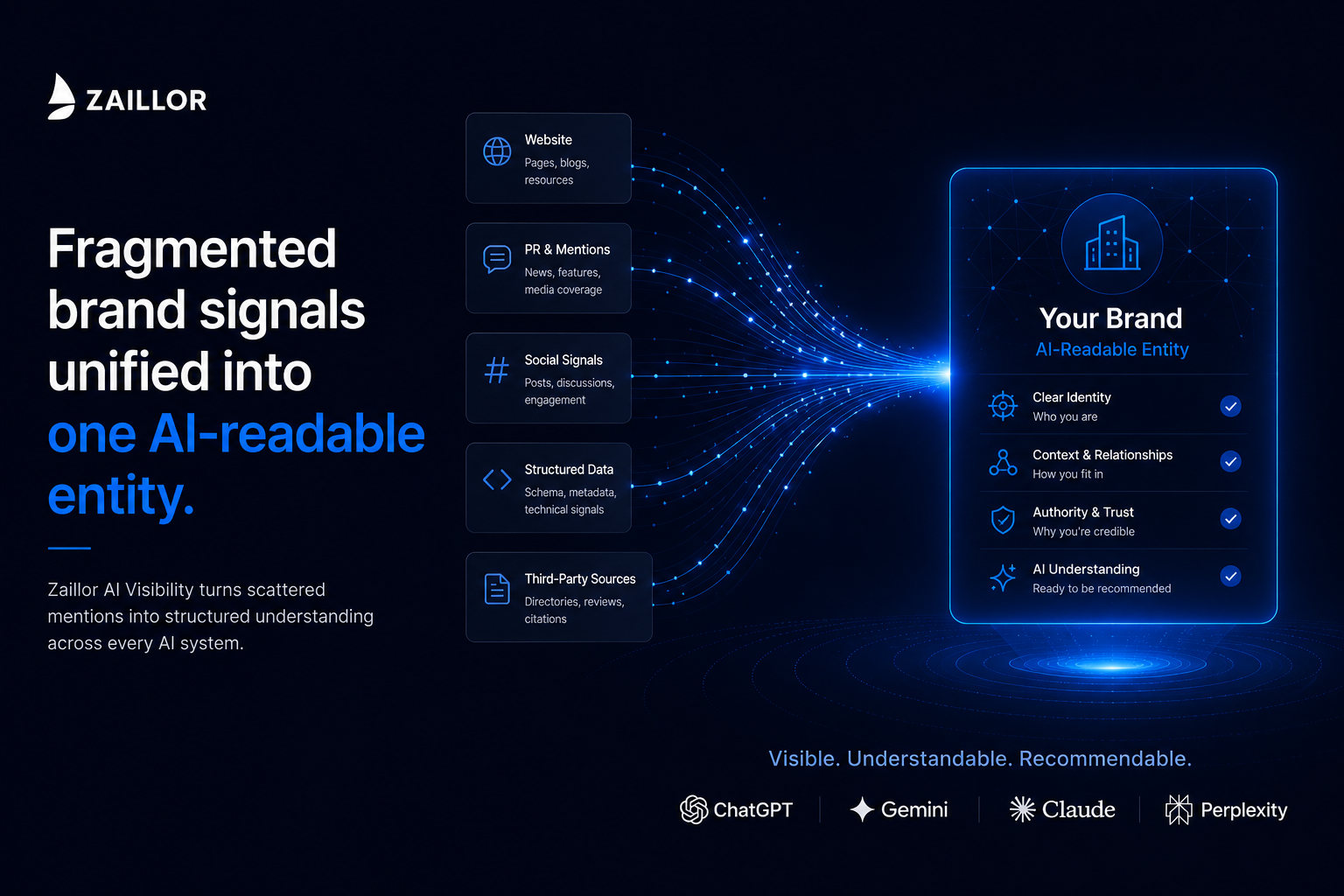
For AI systems, recognition is not just about whether your website exists. It is about whether the signals around your brand agree strongly enough for the system to treat you as one clear entity. The website, structured data, social profiles, directories, review platforms, and third-party references all contribute to that confidence.
This is why Zaillor treats entity clarity as a core AI Visibility layer. AI systems can only cite or recommend a business confidently when they can first resolve what that business is, where it appears, what it offers, and whether those signals point to the same organisation.
From Strings to Things
For most of the history of search, the underlying model was text matching. A page that contained the words in your query, in roughly the right places, with enough authority behind it, would rank. The page was a string of text being matched against another string of text.
Google began moving away from that model publicly in 2012, describing the shift as a move from "strings to things." Rather than just matching text, Google started building a database of real-world entities: people, places, organisations, products, and the relationships between them. This database is what most people refer to as the Knowledge Graph.
AI systems take this further. A large language model does not see your website as a string of pages. It builds an internal representation of entities and how they relate to each other: this organisation, founded in this year, based in this location, offering these products, associated with these people, mentioned alongside these other organisations. When that internal representation is fuzzy or contradictory, the model has less to work with. It might still know your business exists. It is less likely to state things about it with confidence, and far less likely to recommend it by name in response to a query where confidence matters.
| Keyword Era (Strings) | Entity Era (Things) |
|---|---|
| Pages matched against query text | Entities matched against query intent |
| Brand name is a keyword to rank for | Brand name is an identifier that must resolve to one entity |
| Inconsistent descriptions across pages are a minor issue | Inconsistent descriptions across the web reduce entity confidence |
| Backlinks are the primary trust signal | Consistent entity signals across many sources become a trust signal |
| "Do we rank for this keyword?" | "Does the system know what we are, confidently?" |
The Signals That Build a Clear Entity
Entity clarity is not one setting you switch on. It accumulates from a number of smaller signals, each of which on its own seems minor, but which compound when they agree with each other across many sources.
Consistent naming: The exact way your business name is written, including capitalisation, spacing, abbreviations, and legal suffixes, should match across your website, social profiles, directory listings, and any official registrations.
Organisation schema and the sameAs property: Organization schema, implemented as JSON-LD in the page head, is the most direct way to tell search and AI systems what your business is, where it operates, and how it can be verified. The sameAs property lets you explicitly declare that a set of external URLs, such as your LinkedIn page, Wikipedia entry, Crunchbase profile, and official social accounts, all represent the same entity as your website. Without it, systems have to infer that these separate profiles all describe the same organisation, often based on little more than a matching name.
Social profiles and directory listings: Every external profile is a data point that either reinforces or contradicts the picture of your business. A LinkedIn page with an old address, a Google Business Profile with a different phone number than your website, a Crunchbase entry with the wrong founding year. Each is a small disagreement. AI systems drawing on multiple sources have to decide which one to believe, or simply hedge by not stating it at all.
Clear, consistent descriptions: How you describe what your business does should not vary wildly between your homepage, your LinkedIn About section, and your Google Business Profile description. The substance, the category you operate in, who you serve, what you offer, should tell the same story everywhere.
The ECHO Framework by Zaillor
The four properties every business must satisfy to be recognised as one entity by AI systems: Entity Name, Connected Profiles, Harmonised Description, Organisation Data.
- E: Entity Name
- One canonical name, spelling, and legal suffix, used identically across your website, social profiles, directories, and Organisation schema. Drift here is the most common entity clarity failure.
- C: Connected Profiles
- Organisation schema includes sameAs links to LinkedIn, Crunchbase, Wikidata, and G2. Each profile points back to one entity instead of looking like unrelated listings.
- H: Harmonised Description
- What you do, who you serve, and how you are positioned tells the same story on your homepage, About page, and every external profile. Not word for word, but consistent in substance.
- O: Organisation Data
- Address, founding date, leadership, and category in your schema reflect current reality. Outdated facts stated with schema-level confidence are worse than no schema at all.
Zaillor 2026 Entity Clarity Review: Common Findings
Across Zaillor's AI Visibility and crawlability reviews, entity clarity issues tend to follow a repeatable pattern. The business is usually present across the web, but the signals do not agree cleanly enough for AI systems to resolve the business with confidence.
| Entity Clarity Issue | What It Means for AI Visibility |
|---|---|
| Inconsistent business name | AI systems may treat listings as separate or loosely related entities |
| Missing sameAs links | External profiles are not explicitly connected to the official website |
| Outdated Organization schema | AI systems may trust old facts with high confidence |
| Fragmented descriptions | The business category and positioning become unclear |
| Mismatched address, phone, or location data | Local entity confidence weakens |
| Old directory listings | AI systems may retrieve outdated or contradictory information |
| No clear canonical description | AI-generated summaries become vague or generic |
The practical consequence is simple: when AI systems encounter conflicting business signals, they do not always choose the correct version. Sometimes they hedge. Sometimes they compress the business into a generic description. Sometimes they leave the business out of recommendations entirely. Entity clarity work is the process of reducing that ambiguity.
Knowledge Graphs: The Shared Idea Behind Different Implementations
Google has its Knowledge Graph. Other AI platforms build their own internal representations of entities and relationships, whether through training data, retrieval systems, or their own structured databases. The specific implementations differ, and most are not publicly documented in detail. But the shared underlying objective is the same: connect organisations, products, people, and concepts into a structure where the relationships between them are understood, not just the individual facts.
Wikidata plays an outsized role here because it is one of the few large, structured, openly available entity databases, and multiple AI systems and search engines draw on it as a reference point for entity resolution. A Wikidata entry for your organisation, even a modest one, gives external systems a stable anchor point: a single, structured record that other sources can be checked against. None of this requires your business to be a household name. It requires the information that exists about your business, wherever it exists, to agree with itself.
The Patterns We Keep Seeing
A handful of entity clarity problems show up again and again across audits, often in businesses that otherwise have strong websites and solid content.
The name has drifted: Over time, small variations creep in. The website says one thing in the footer and another in the meta title. Social bios were set up by different people at different times with slightly different phrasing. None of these were deliberate decisions. They are just drift, the natural result of a business existing across many platforms managed by different people over several years.
The description has fragmented: The homepage describes the business one way. The About page describes it slightly differently, written at a different time by a different person. The LinkedIn page describes it in terms of an earlier positioning that has since evolved. None of these descriptions are wrong exactly. But read together, they do not cohere into one clear story.
Organisation details are missing or outdated: No Organization schema on the site at all, so there is nothing machine-readable declaring the basics. Or schema that exists but has not been updated since an office move, a rebrand, or a change in leadership. The structured data is technically present and technically wrong.
The digital footprint is fragmented: Profiles exist on LinkedIn, Crunchbase, industry directories, and review platforms, but they were set up once and never revisited. No sameAs links connect them back to the website. From the outside, these look like a scattering of loosely related listings rather than one entity with a consistent presence.
One thing worth noting: none of these problems are about hiding information or being deceptive. They are almost always the accumulated result of normal business activity: office moves, rebrands, new team members updating different platforms, old listings nobody remembered to update. The issue is not intent. It is drift, and drift compounds quietly until something tries to read all of it at once.
What This Looks Like in Practice
Scenario A: The Fragmented Identity. A consulting firm has a polished website, an active LinkedIn page, and listings on three industry directories. The website lists the company as "Altair Consulting Pvt Ltd". LinkedIn shows "Altair Consulting". One directory has an old address from before the firm relocated. None of the profiles link to each other. When a prospective client asks an AI assistant about the firm, the response is vague: it can confirm the firm exists and operates in a general area, but hedges on specifics and does not mention any of the firm's actual specialisations. Result: The AI can detect that something called Altair Consulting exists in multiple places, but cannot confidently resolve these into one entity with one set of facts, so it says very little.
Scenario B: The Connected Entity. A SaaS company adds Organization schema to its homepage with consistent name, founding date, address, and description. The schema includes sameAs links to the company's LinkedIn page, Crunchbase profile, and G2 listing. The team does a one-time pass to align the wording of the company description across all of these profiles, not word for word, but consistent in substance. Result: A single afternoon of alignment work gives external systems a stable, cross-referenced identity to resolve queries against.
Scenario C: The Outdated Anchor. A retail brand implemented Organization schema two years ago, around the time of its last office move. Since then, the company has rebranded its logo, changed its registered address again, and restructured its leadership. The schema was never updated. It is syntactically valid and passes structured data tests, but every fact it asserts is now out of date. Result: Technically correct structured data that has not been maintained becomes actively misleading, which is arguably worse than having no structured data at all.
What You Should Do Now
Step 1: Map your entity footprint. List every place your business has a presence: website, social profiles, directories, review platforms, any registrations. For each one, note the exact business name as written, the description, and key facts: address, founding date, category. Most businesses have never done this exercise and are surprised by how many small inconsistencies surface.
Step 2: Pick one canonical version of everything. Decide, once, on the exact name, the core description, and the key facts you want represented everywhere. This does not need to be exhaustive or perfectly worded. It needs to be the single version that every other instance can be checked against.
Step 3: Align and connect. Update your website's Organization schema to reflect the canonical version, including sameAs links to your other key profiles. Then work through your social profiles and directory listings, aligning each one to the canonical description and correcting any outdated details. This is rarely a large technical project. It is usually a checklist, executed once, and then revisited periodically as the business changes.
Frequently Asked Questions
- What is the difference between entity clarity and SEO?
- Traditional SEO is largely concerned with how well individual pages rank for specific search terms. Entity clarity is about whether AI systems and search engines can identify your business as one consistent, recognisable thing across everywhere it appears. A page can rank well for a keyword while the underlying business remains ambiguous as an entity. Entity clarity is a foundational layer that affects how confidently any system can talk about your business at all.
- Do I need a Wikipedia page to have entity clarity?
- No. A Wikipedia page can help, particularly for well-known organisations, because it is a widely referenced source for entity resolution. But entity clarity for most small and medium businesses comes from much simpler things: a consistent name, accurate Organization schema, and descriptions that agree with each other across your website, social profiles, and directory listings.
- What is sameAs and why does it matter?
- sameAs is a schema.org property that lets you explicitly declare that other URLs, such as your LinkedIn page, Wikipedia entry, and Crunchbase profile, represent the same entity as your website. Without it, systems trying to understand your business have to infer that these separate profiles all describe the same organisation, often based on little more than a matching name. With it, the connection is stated directly.
- How often should we review our entity information?
- Any time something material changes: office relocation, rebrand, leadership change, change in legal entity name, or significant repositioning of what the business offers. Outside of those triggers, a periodic review once or twice a year is reasonable for most businesses.
- We are a small business. Does entity clarity even apply to us?
- Yes, arguably more so. Large, well-known brands often have enough signal volume that minor inconsistencies get absorbed without much effect. Smaller businesses have far less signal to begin with. A handful of inconsistencies represent a much larger share of the total information available about the business.
- How does entity clarity affect AI recommendations?
- Entity clarity affects AI recommendations by increasing the confidence AI systems have that a business is real, current, and consistently represented across the web. When the same name, description, category, and identifying details appear across a website, schema, social profiles, and directories, AI systems are more likely to mention or recommend the business accurately.
- What is the ECHO Framework by Zaillor?
- The ECHO Framework by Zaillor is a model for improving Brand Entity Clarity for AI Visibility. ECHO stands for Entity Name, Connected Profiles, Harmonised Description, and Organisation Data. These four properties help AI systems recognise a business as one consistent entity across its website, structured data, social profiles, and external listings.
- What does Zaillor do in this area?
- Zaillor's audits assess entity clarity against the ECHO framework: checking whether Organisation schema is present, current, and includes sameAs connections to your key external profiles, and comparing how your business is described across your website and other platforms to identify inconsistencies. Where gaps exist between how AI systems currently describe a brand and what is actually accurate, Zaillor implements the structural and content changes needed to close them.
The Bottom Line
Across this series we have looked at whether AI crawlers can reach your content, how your sitemap tells them what matters, and how structured data tells them what your content means. Entity clarity sits underneath all of it. It answers a more basic question first: does the system know, confidently, what this business is?
A business can have perfect crawlability, a pristine sitemap, and rich structured data on every page, and still be described vaguely by AI systems if its name, description, and key facts disagree with each other across the rest of the web.
If AI systems are increasingly modelling the world as entities and relationships rather than pages and keywords, then being a clear, well-defined entity is no longer a nice-to-have. It is the precondition for being confidently recommended at all.