SaaS & AI Search
How to Get Your SaaS Recommended by Gemini: A Simple Guide for 2026
By Ayush Gupta, Senior SEO Specialist, Zaillor · 11 min read · 4 November 2026
Learn how Gemini picks which software to recommend, and the simple steps that help your SaaS appear when buyers ask Gemini or AI Mode for tools.
Ask Gemini for “the best invoicing software for a small agency in India” and you may get a short list: five or six tools, one line on each, sometimes a comparison table. Buyers can read that shortlist before they open a product website.
Plenty of good SaaS products never make that list. They may have happy customers, useful features and solid Google rankings, yet Gemini does not name them. If Gemini cannot find, understand and trust your product, it may recommend another option instead.
Why Gemini matters for SaaS
Gemini is both a standalone app and part of Google Search’s AI Mode. When buyers ask either experience for software, they may see a synthesized shortlist rather than a page of links. This guide focuses on Gemini because it is closely connected to Google Search and its public guidance.
Being recommended means your product is named in an answer, with a reason, when someone asks for software in your category. It is different from ranking in a conventional list of search results: Gemini may mention only a few products, and the buyer may start comparing them immediately.
What Google says about how Gemini finds answers
Gemini can ground answers in Google Search
Google says Gemini Apps can ground responses in content from the Google Search index. For AI features in Search, Google says its core ranking and quality systems still apply and that query fan-out can run several related searches to help build an answer. In practical terms, pages need to be accessible and eligible to appear in Search before they can be useful sources.
There is no special code or shortcut
Google says there are no additional requirements to appear in AI Overviews or AI Mode beyond being indexed and eligible to show a snippet. It does not promise that a particular optimization will earn a recommendation. Standard SEO still matters. Structured data can state product facts clearly, but it does not guarantee inclusion.
Google-Extended is a separate control
Google-Extended is a robots.txt control for whether Google may use content to train future Gemini models and ground responses in Gemini Apps. Google says it does not affect inclusion or ranking in Google Search. Blocking it can therefore limit use in Gemini Apps without itself blocking Google Search visibility.
Google has not published a checklist of ranking factors for which products Gemini recommends, and there is no way to buy a place in its organic recommendations. Gemini can also make mistakes. The practical goal is to make accurate product facts easy to find and verify.
How software discovery is changing
Classic search gives buyers a list of links to compare. Gemini and AI Mode can give them a shorter set of named tools with reasons, so the buyer may open only a few product pages.
| Classic Google search | Gemini and AI Mode |
|---|---|
| Short terms such as “CRM software” | Full questions such as “best CRM for a 20-person sales team in India” |
| Many links, ads and review sites | A synthesized shortlist with brief reasons |
| The buyer compares several websites | The answer may shape which products the buyer checks |
| Visibility is often measured through rankings and clicks | Teams also need to check mentions, accuracy and cited sources |
Three recent figures help show why SaaS teams are paying attention:
- 1 billion-plus monthly users: Google said the Gemini app passed one billion monthly active users in August 2026.
- AI chatbots ranked first: G2’s 2026 survey of 1,076 B2B software decision-makers found AI chatbots had become the top source influencing which vendors reached buyers’ shortlists.
- Three times longer: Alphabet said AI Mode queries were, on average, three times longer than traditional searches.
Source notes: Google, “Google’s Gemini app hits 1 billion monthly active users” (11 August 2026); G2 research reported by PR Newswire (15 April 2026); Alphabet Q3 2026 earnings call (28 October 2026). These figures are not specific to India and do not measure Gemini recommendations directly. Treat them as context, not a prediction for any product.
How Gemini decides which tools to recommend
Google has not published specific recommendation rules. Based on its documented guidance about Search, grounding and AI features, four useful questions can help SaaS teams review their visibility:
1. Can Gemini find your product?
Keep important pages crawlable, indexed and eligible to show a snippet. Check that robots.txt does not unintentionally block Googlebot, key pages are not marked noindex, and essential information is present in content that search systems can access. If you want Gemini Apps to use your content for grounding, review whether Google-Extended is blocked.
2. Is it clear what your product is?
State your category, audience and main use plainly. Keep the product name and short description consistent across your homepage, About page, LinkedIn profile, review sites and app marketplaces. SoftwareApplication structured data can make facts such as a product name, category, price and rating explicit, when those details are accurate and visible.
3. Is there independent evidence?
Your own website is important, but relevant reviews, honest comparison pages, case studies, partner listings and industry publications can provide additional context. Focus on genuine, useful proof; do not manufacture mentions or reviews.
4. Do your pages answer buyer questions?
Buyers may ask about pricing, integrations, security, use cases and alternatives. Clear pages covering these topics give readers and search systems something specific to check. A pricing page that only says “Contact sales” gives little information to compare. Keep details current and explain limitations accurately.
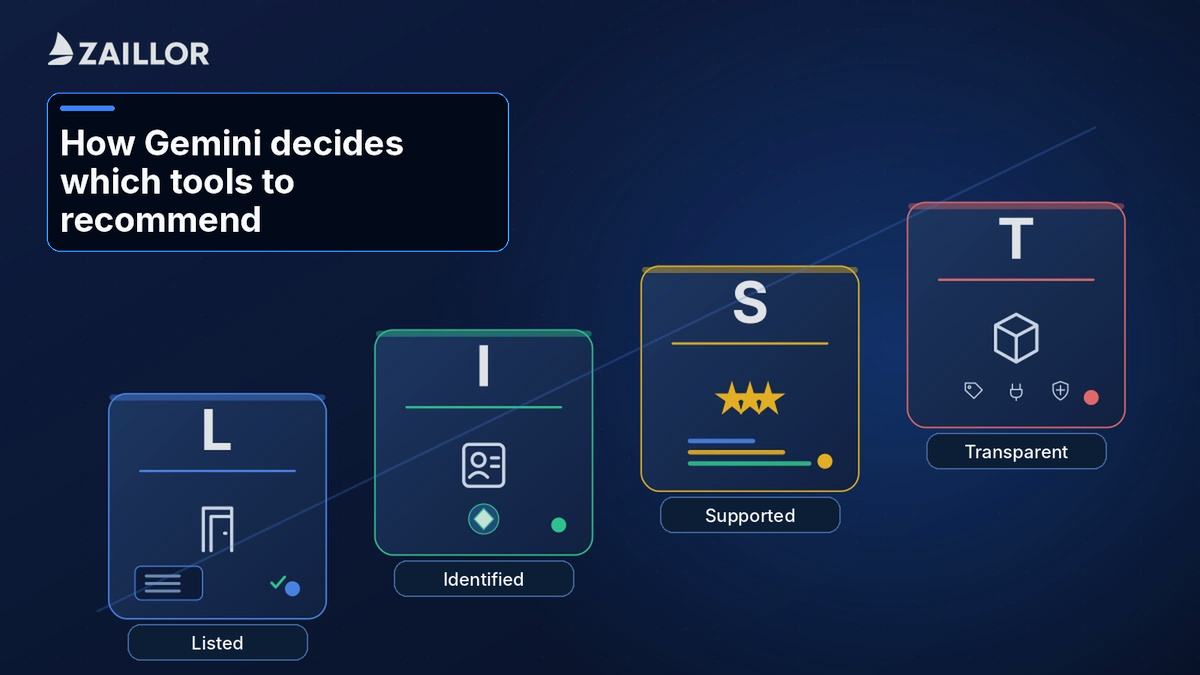
The LIST Framework brings those checks together: Listed pages are crawlable and eligible; Identified products have a clear, consistent name, category and audience; Supported claims have real reviews and relevant mentions; and Transparent pages explain pricing, integrations, security and alternatives.
How to check what Gemini says about your SaaS
Run a small, repeatable prompt review and record what you see. Results can vary, so treat a single response as an observation rather than a stable ranking.
- Write 15 questions buyers might ask: category recommendations, competitor alternatives and product-fit questions.
- Ask them in Gemini and Google AI Mode. Use a fresh session where practical.
- Record whether your product is named, its position, the reason given and any incorrect details about price, features or integrations.
- Note linked sources where shown, including your pages, review sites and competitor pages.
- Fix factual errors at the source. For missing mentions, review whether your pages answer the query and whether credible external evidence exists.
- Repeat monthly. In GA4, check AI Assistant referrals and Organic Search separately when reviewing visits from Gemini and AI Mode.
Common mistakes that make a SaaS hard to recommend
- A vague homepage: Replace broad phrases such as “the all-in-one platform for modern teams” with a precise description of the product, audience and job it does.
- Hidden pricing: If prices are not public, explain how pricing works or provide a starting point when appropriate. Keep every published figure accurate.
- No useful comparisons: Buyers compare tools. Create fair, factual pages that explain fit and differences without unsupported superiority claims.
- Outdated review profiles: Keep listings and product details current, and invite customers to leave honest reviews without scripting or incentivizing claims.
- Blocking the wrong crawler: Check what each robots.txt rule controls before blocking it. Google-Extended and Googlebot have different roles.
Examples: clarity and evidence in practice
An HR tool nobody can place: A fictional Bengaluru HR software company calls itself “the people platform for the future of work,” hides pricing behind a demo form and has old review profiles. A buyer asking for HR software for a 100-person Indian company may get competitors that are easier to describe. The example is illustrative, not a real client result.
An invoicing app with useful pages: A fictional Pune invoicing tool explains its audience, publishes pricing and integration pages, compares its features fairly and regularly asks customers for honest reviews. These pages make its product facts easier to check. This example is illustrative, not a real client result.
A developer tool with an outdated price elsewhere: A fictional Noida API monitoring product is named by Gemini, but an old price on a third-party page is repeated. Being recommended is not the finish line; outdated information on the wider web can still affect how a product is described. This example is illustrative, not a real client result.
What to do next
- Run a baseline prompt test. Start with buyer questions, record mentions and sources, and repeat the same checks monthly.
- Improve the pages that answer buyer questions. For many SaaS products, that includes the homepage, pricing, a key use case, integrations and a fair comparison page. Choose pages based on the actual gaps you find.
- Build credible evidence beyond your site. Keep listings current, ask customers for honest reviews, publish genuinely useful material and correct outdated facts where they appear.
These steps can make a product easier to find and understand; they cannot guarantee a Gemini recommendation. Check what the platform actually says and improve the evidence where it is unclear or wrong.
Frequently asked questions
Can I pay to be recommended by Gemini?
You cannot buy a place in Gemini’s organic recommendations. Paid placements, where offered, are advertising and should be distinguished from an organic answer.
Does Gemini use Google Search to answer software questions?
Google says Gemini Apps can ground answers in content from the Google Search index. Gemini may also draw on information learned during training, so older product details can still appear.
Should I block Google-Extended?
That depends on whether you want Google to use your content for Gemini training and grounding in Gemini Apps. Google says blocking Google-Extended does not affect Google Search rankings.
Does schema markup help a SaaS appear in Gemini?
Structured data can express accurate product facts in a machine-readable format, but Google does not require special markup for its AI features and schema alone does not earn a recommendation.
How long does it take to appear in Gemini answers?
There is no fixed timeline or guarantee. Search systems need to recrawl updated pages, while independent evidence may take time to accumulate. Check the same buyer questions regularly.
How can Zaillor help SaaS companies?
Zaillor measures how AI platforms describe and recommend products, identifies gaps in pages, structured data and listings, and supports agreed improvements. It cannot guarantee a recommendation.