AI Search & AI Visibility
When Should You Rewrite a Page, Add Schema or Correct an External Listing?
By Samar Pratap Singh · 15 min read
A missing explanation, unclear markup and an outdated profile require different work. Choose the correction by locating the evidence gap and confirming the facts.
From AI Visibility Action to Audit · Part 4 of 4

Match the correction to the information gap: page content, schema or an external listing.
A service page does not explain whether installation includes lighting. The audit also flags missing schema, while a directory describes an old version of the offer. A team could rewrite the page, add markup or edit the listing. Each task looks reasonable. Each addresses a different part of the problem.
The choice becomes difficult when the report presents all three as ways to improve AI visibility. A business owner may approve the easiest task without knowing whether it resolves the missing answer. A developer may add valid markup while the writer waits for the actual service details.
We would begin with the sentence a buyer needs to understand and the source that should establish it. Once those are clear, the implementation choice becomes smaller and easier to explain. Sometimes the right job is one paragraph and a matching markup update. Sometimes it is a correction on a profile outside the website.
This is the fourth article in From Audit to Action. Parts 1 to 3 covered audit priorities, selecting five pages and tracing incorrect business facts. This final piece connects those decisions to the work itself: which correction should you commission, and what should count as completion?
What does choosing the right correction involve?
Imagine a shop with a visitor guide, labels on its shelves and an entry in a town directory. If the guide omits delivery conditions, a better shelf label will not supply the explanation. If the directory gives yesterday’s opening hours, rewriting the visitor guide leaves that entry unchanged.
The visitor guide represents visible website content. The shelf labels represent structured descriptions of the information already present. The town directory represents an external listing. The useful lesson is that a correction should reach the place where the relevant information is missing, unclear or wrong.
Correction selection means matching a verified information gap to the page, markup or external source that can resolve it, with the necessary factual approval and a check of the published result. The choice is about the job the information must perform.
Identify the information gap before choosing a tool
Start by identifying which of these situations you can actually demonstrate:
- A missing answer: the relevant page does not explain something a buyer needs to decide.
- An inaccurate fact: an owned page or external source publishes information that is wrong or obsolete.
- A representation gap: the visible facts are clear, but applicable markup is absent, incomplete or inconsistent.
These situations can overlap. A service page might need a clearer explanation and a matching schema correction. What matters is that the proposed work follows the verified gap. “Add schema to improve visibility” is less reviewable than “update the organisation’s obsolete address in markup so it agrees with the approved public address”.
Check access before judging the quality of the information. Google says supporting pages in AI Overviews and AI Mode must be indexed and eligible for a search snippet. Its guidance also says no special schema is required for those features. An accidental eligibility barrier calls for a technical correction before optional additions. These requirements concern Google Search. (Source: Google Search Central, AI features and your website.)
A page can also be accurate but hard for a reader to find. If the answer already exists on a suitable page, an internal link or clearer navigation may be the useful task. Diagnose that condition before commissioning a rewrite of material that already performs its job.
When should you improve the page content?
When the buyer’s important question remains unanswered
Choose a content improvement when the relevant page lacks a useful explanation. For a contractor, that might be what the quotation includes. For a retailer, it might be whether two similar products suit different conditions. For a software business, it might be what the customer receives and what they still have to configure.
Read the page without relying on knowledge held by the sales team. Can someone tell what is offered, who it suits and which conditions apply? A broad claim such as “complete solution” can hide several unresolved questions. A concrete scope section can answer them without adding a long general introduction.
When existing wording creates the wrong impression
A page may contain the facts but place them beside a headline that overstates the offer. “Nationwide installation” followed by a small qualification about three supported regions leaves a reader to resolve the conflict. Confirm the actual coverage, then align the headline and explanation.
Rewrite only as much as the problem requires. Keep accurate specifications, useful examples and distinctive descriptions. Replace the vague promise, add the missing condition or move the answer to a more useful position. A complete rewrite is appropriate when the page’s structure repeatedly prevents understanding, rather than because the audit uses the word “content”.
When the replacement information can be supported
Ask for approved scope, specifications or a relevant example before drafting. If nobody can confirm whether lighting is included, the writer cannot settle the offer through better wording. The factual decision belongs to the business. Once it is settled, the page can explain the default scope and any separately quoted work.
A useful change brief names the reader’s question and the specific section that will answer it. “Add the preparation work included in a resurfacing quote” gives a writer something to deliver. “Make the service page more authoritative” still leaves the actual information requirement open.
When should you add or correct schema?
When it describes facts the page already establishes
Structured data provides explicit descriptions of page content and entities using defined types and properties. Choose it when there is a relevant representation task: identifying the organisation, describing a product or recording other information supported by the page and applicable guidance.
Google’s Organisation guidance says the markup can help it understand administrative details and distinguish organisations in search. That is a reason to represent the business accurately. It is not proof that adding the markup will cause an AI answer to recommend the business. (Source: Google Search Central, Organization structured data.)
The important implementation question is whether the proposed values are truthful and appropriate. A service area should describe actual coverage. A product specification should use the approved value. Do not fill a recommended field with an invented answer merely to remove a warning.
When existing markup conflicts with current content
A page can show the new address while its JSON-LD still contains the old one. In that case, correcting the markup addresses a concrete contradiction. Check existing output before adding another block; two implementations may otherwise publish competing versions of the same information.
Google requires structured data to represent the page accurately and keeps technical validation distinct from its quality requirements. It also does not guarantee rich result display even when markup is correct. A successful test supports an implementation check, rather than a claim that a visibility outcome has occurred. (Source: Google Search Central, General structured data guidelines.)
If content is being changed at the same time, prepare the schema from the approved final version. A writer and developer can work in parallel from the same facts. Publication should then leave the visible explanation and relevant markup in agreement.
When should you correct an external listing?
When the discrepancy is on that source
Choose a listing correction when an active profile publishes the wrong business name, address, category, service description or other relevant fact. A correct website does not itself edit that profile. If the listing appears in the material returned for an important question, inspect the actual statement before assigning work.
Part 3 explained why a visible citation is an investigation lead rather than proof of the full origin of an answer. The same discipline applies here. Correct an observed source discrepancy because it is inaccurate, while keeping any claimed effect on an AI answer separate from the source correction.
When there is a legitimate correction route
Use the existing owner account or the platform’s claim, suggestion or editorial correction process. For Google Business Profile, the official guidance allows owners to edit details and explains that updates are reviewed before appearing live. A submitted request therefore remains pending until the public profile shows the change. (Source: Google Business Profile Help, Edit your Business Profile.)
Do not create a duplicate listing to avoid resolving ownership. Do not change a historical article simply because it records a former location correctly for its date. The task is to correct information presented inaccurately as current, or clarify context where the publisher’s process permits it.
A listing job needs an exact URL, approved replacement and responsible account owner. If access is unavailable, record the blocker and the correction request. Filling the gap with unrelated new profiles may add activity without resolving the original contradiction.
Correction Fit checklist
Use these four questions to explain why a particular job belongs in the plan. This is a public editorial decision aid, not a ranking formula.
| CORRECTION FIT CHECKLIST 1 Gap What is missing, misleading or inconsistent for the intended buyer question? 2 Source Where is that information published, and who can change it? 3 Dependency Which fact, access issue or approval must be settled first? 4 Check What will establish that the correction is live and accurate? To cite this checklist: Samar Pratap Singh (2026). Correction Fit checklist. From Audit to Action, Part 4. |
|---|
When more than one correction is needed
A changed service area may require a page edit, a markup correction and updates to active profiles. That is a connected factual change across several sources. Approve one clear description, then use it consistently without forcing every platform to reproduce the same sentence.
For a connected change, work in this order where the dependencies require it:
- Confirm the current business fact and the public wording.
- Improve the relevant visible content if it is missing or misleading.
- Align applicable markup and request necessary external corrections.
- Verify each publication separately, keeping pending profile reviews visible.
The order is a dependency guide rather than a rule that external work must always wait. A profile owner can start a verified address correction while the developer prepares the same change on the website. The important condition is agreement on the approved fact.
Illustrative gaps and appropriate work
| Observed gap | Appropriate correction | Completion check |
|---|---|---|
| Service scope is absent from the relevant page | Add a focused, approved scope explanation | The page answers what is included |
| Clear page, obsolete address in JSON-LD | Correct the existing organisation markup | Relevant fields match current visible facts |
| Current website, wrong active directory address | Correct the existing external profile | The approved address is live on that profile |
| Service area changes across several sources | Coordinate content, markup and profile updates | Each source checked; pending reviews recorded |
| Answer exists but relevant pages do not link to it | Improve the internal route to the answer | Readers can reach the appropriate source |
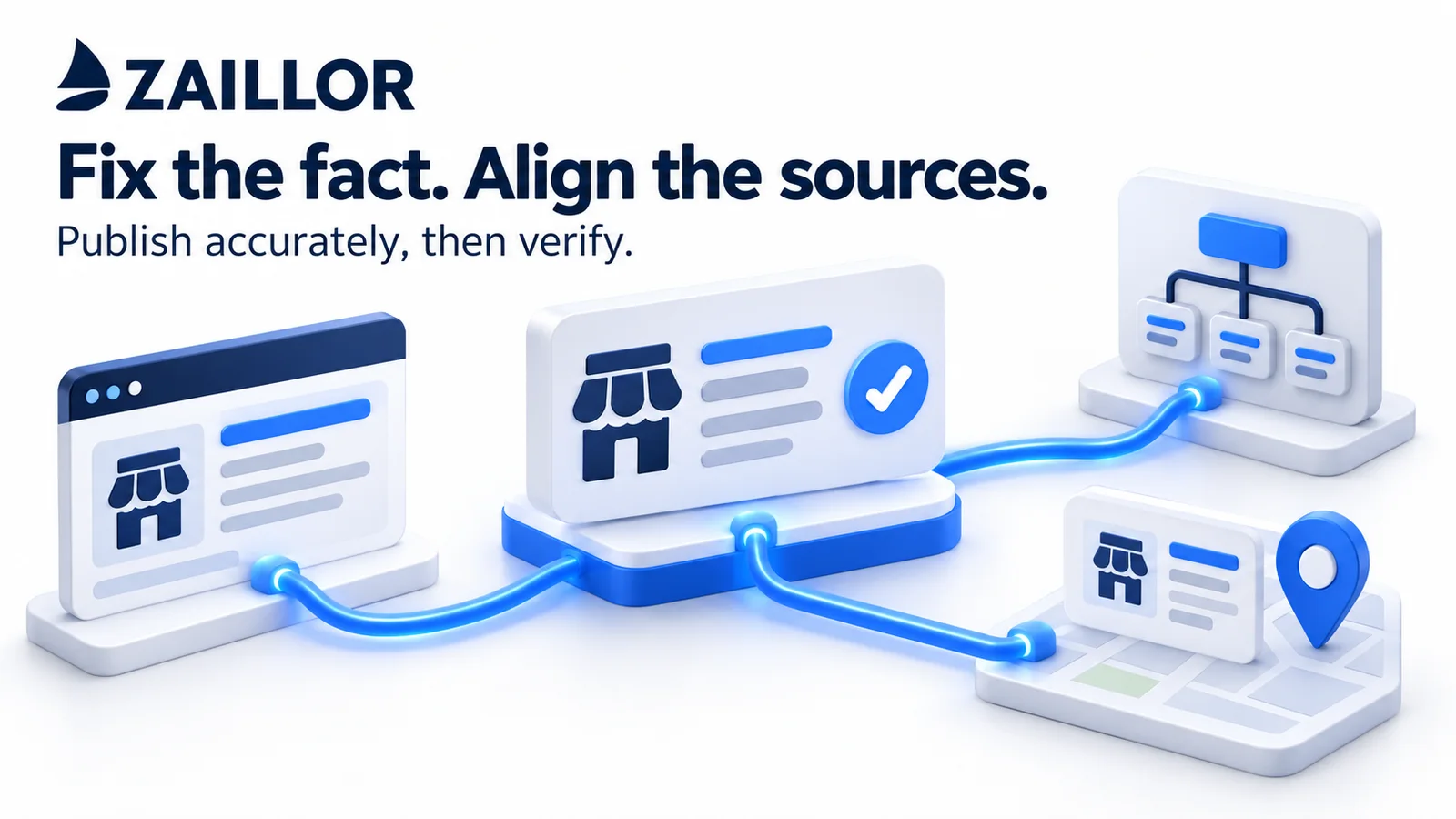
Use one approved fact across relevant sources, then verify each published correction.
The mistakes that send the work in the wrong direction
Commissioning a rewrite before identifying the gap
A full rewrite can remove useful material and delay the correction. State the missing answer first. If one section can supply it, start there and review the resulting page before expanding the scope.
Using markup to compensate for an absent explanation
A schema block is a poor place to hide service conditions the page never explains. Confirm the offer, publish the explanation where readers need it and use relevant markup to describe the resulting content.
Adding new listings before correcting an existing contradiction
New destinations may have a separate reason to exist, but they do not edit the old profile. Keep the current discrepancy assigned to someone who can pursue its actual correction route.
Reporting implementation as an answer-engine result
A live page, valid markup and an approved profile edit establish different implementation outcomes. Later monitoring can show whether an answer or citation changed under recorded conditions. Report that observation without assigning causality to one chosen edit from a wider batch.
Three situations that lead to different choices
| Illustrative mistake: schema around an unanswered question An installer’s page never explains whether lighting is included. The team adds markup describing the service but obtains no approved scope statement. Result: the buyer’s question remains unanswered. The first useful job is to confirm the offer and add a visible explanation. |
|---|
| Illustrative correction: keeping clear content and repairing markup A retailer’s page clearly identifies its business and current contact address. Existing organisation markup still contains an obsolete address. Result: the defined job is to correct that markup and compare its values with the approved visible facts, rather than commission a new homepage. |
|---|
| Illustrative combination: one fact with several active copies A service business changes its supported regions. Its service page, markup and active directory description still publish the previous coverage. Result: one approved scope description supports coordinated edits, with each live publication checked and external review statuses tracked. Subsequent AI answers remain an observation to monitor. |
|---|
What you should do now
Step 1: Give the proposed task a business reason
At Zaillor, we connect the correction to the buyer question and the evidence gap it should resolve. Choose the affected page or profile, confirm what is wrong or absent and identify the fact owner. That gives the implementation team a decision they can explain rather than a list of tools to deploy.
Step 2: Write a brief that can be completed and checked
Include four practical details in the change brief:
- The exact URL or profile and the section or field affected.
- The approved replacement information or explanation to add.
- The responsible editor, developer or profile owner, including any pending approval.
- The live check that will confirm publication and accuracy.
Keep the job as small as the evidence allows, but complete the connected changes it actually requires. An address correction is unfinished if a prominent owned page still publishes the obsolete address. An external request remains pending until its outcome is visible.
Step 3: Use the published result to guide the next decision
Review the changed source as a buyer, check relevant markup and confirm external updates. Then return to the recorded questions and observe subsequent answers. If the information is now accurate but the original issue persists, investigate the remaining evidence rather than repeating the same edit without a new diagnosis.
Frequently asked questions
Q: Should we rewrite a page whenever AI visibility is weak?
A: Start with a specific information or access gap. A page rewrite is useful when the explanation is missing, misleading or difficult to understand. If the page already supplies a clear answer, investigate markup, external contradictions or the route to the information before approving more copy.
Q: Can schema replace a missing service explanation?
A: The relevant facts should be available to readers. Confirm the service scope and publish a useful explanation, then make applicable markup describe it accurately. Treat schema as structured representation of the approved information.
Q: Does valid schema guarantee better AI answers?
A: No. Validation checks and platform outcomes are different. Google does not require special schema for its AI search features, and correct markup does not guarantee rich result display. Verify implementation and monitor relevant answers separately.
Q: When should we correct a listing before rewriting the website?
A: When the website is already accurate and the active listing contains the verified discrepancy. Use that listing’s legitimate correction route. If several sources disagree, confirm the current fact and coordinate the necessary edits.
Q: What if all three corrections are needed?
A: Give them one approved factual reference and separate publication checks. Content, markup and profile work can run in parallel where dependencies permit. Track outstanding approvals or reviews so the combined job is not marked complete too early.
Q: What does Zaillor do when choosing between these corrections?
A: We relate the observed gap to the relevant buyer question, confirm the facts and identify the source that needs work. The implementation plan can then specify page changes, applicable schema and eligible external corrections, with clear ownership and verification.
| The next action should follow the next evidence gap A useful correction gives the business a clearer public fact or a more complete answer. Once it is published and checked, the next decision should follow what remains unresolved. Keep the fact owner, source and verification record together, so future changes to the offer reach the information buyers will actually encounter. |
|---|
Get your free AI Visibility Score zaillor.com/get-audit
Further reading
Structured data and AI visibility
Entity clarity and AI visibility
Sources and references
Primary guidance consulted on 6 October 2026. Examples in this article illustrate decisions; they do not report measured client outcomes.
| Google Search Central | AI features and your website |
|---|---|
| Google Search Central | General structured data guidelines |
| Google Search Central | Organization structured data |
| Google Business Profile Help | Edit your Business Profile |