AI Search & AI Visibility
AI Gets Your Business Wrong. Where Should You Start Correcting It?
By Samar Pratap Singh · 13 min read
Trace inaccurate business claims to the evidence available, correct the relevant public information and verify publication separately from later AI answers.
From AI Visibility Action to Audit · Part 3 of 4

An AI answer names your business correctly, then sends the buyer to an office you left two years ago. Your contact page shows the current address. Rewriting that page may feel like progress, but it cannot correct an old address on a directory you have not checked.
A second answer might describe a service you stopped offering. A third could combine your name with another company’s product range. The wording looks like one problem: AI has the facts wrong. The appropriate correction depends on the claim, the available evidence and where the information appears.
It is tempting to respond with a broad content refresh. Before commissioning one, identify which sentence is wrong and what evidence would establish the replacement. That makes the work specific enough to assign and check.
This is Part 3 of From AI Visibility Action to Audit. The first two articles covered choosing audit priorities and five website pages. Here, we focus on a narrower decision: where to begin when an answer misrepresents the business.
What does correcting a business fact involve?
Imagine a shop moves to a new street. Its own sign is current, but a printed visitor guide still gives the old address. The shop sign represents owned information; the guide represents an external source; a visitor’s directions represent the resulting answer. Correcting the sign again misses the guide. If both sources are accurate and the visitor misreads them, the investigation changes.
Business fact correction is the process of recording an inaccurate claim, confirming the current fact, inspecting the sources available to you and correcting the relevant information through a legitimate route. Rechecking answers comes afterwards. A published correction and a changed AI answer are separate outcomes.
Start with the exact claim, rather than the whole answer
“AI does not understand us” is too broad to assign. “This answer says we install residential kitchens, although we supply commercial kitchen equipment only” identifies something a person can investigate. Keep the sentence, the prompt and the conditions under which it appeared.
Separate an incorrect fact from an omission or a judgement. An answer that leaves your business out of a shortlist creates a different question from an answer that gives the wrong phone number. “Not suitable for a small project” may be an interpretation of unclear minimum-order information. It needs examination before being labelled false.
Even apparently simple facts can have more than one valid meaning. A trading name can differ from a registered company name. A business may have started trading before it incorporated. Decide which fact the buyer needs and state its context clearly, rather than forcing every source to display one undifferentiated date or name.
Record enough context to reproduce the problem
Save enough context to reproduce and compare the problem:
- The full answer and exact prompt.
- The date, platform and available model or mode details.
- Whether web search was used.
- The language and relevant location settings.
- Any visible citations.
A screenshot is useful, but a text copy makes it easier to compare the disputed sentence later.
Run a fresh conversation if previous messages supplied old information or assumptions. Record that change rather than replacing the original evidence. A follow-up answer inside a corrected conversation can show that the system accepted your instruction; it does not show what an independent buyer will receive.
OpenAI explains that web-search answers may include citations and a Sources view. Its guidance also advises checking whether a cited page supports the answer because results can be incomplete, outdated or incorrect. This makes citations useful investigation leads, rather than a guarantee of factual accuracy. (Source: OpenAI Help Centre, Searching the web with ChatGPT.)
Without a visible source, the origin may remain unknown. Do not claim that an error came from model training, a particular directory or an inaccessible cache just because the wording resembles old information. Record what you can observe and inspect the public sources most relevant to the disputed fact.
Confirm what the correct public fact should be
Ask the person responsible for the service, location or product to confirm the replacement wording. An old brochure and a newer page may disagree because the offer changed, or because one was never approved. Publishing a third version before settling the fact creates another conflict.
For a service area, clarify whether the business has an office, delivers products, installs equipment or accepts remote projects in the location. Those statements are different. “We serve Jaipur” should not imply a staffed Jaipur branch when the work is delivered from elsewhere.
For product information, use approved specifications and applicable product documentation. For trading details, distinguish the public brand from the legal entity where that distinction matters. Keep internal evidence private if it contains confidential information; publish only the information needed to explain the fact accurately.
Write a short correction record containing:
- The disputed claim.
- The approved replacement.
- The supporting evidence.
- The person responsible.
- The date confirmed.
This becomes the reference for the website editor, profile owner and anyone changing structured data. It also prevents a future update from restoring the obsolete wording.
Follow the available evidence to the right correction
When a cited page contains the wrong fact
Open the cited URL and find the specific statement. Check whether it is current content, a dated article, an archived page or a third-party summary. A two-year-old report can correctly describe where the business operated then. Its historical wording may be legitimate even when an answer wrongly treats it as current.
If the live page presents obsolete information as current, use its owner’s editing or correction process. Give the exact URL, sentence and approved replacement. If it is your page, correct it directly and inspect other prominent pages that repeat the same fact.
When the source is your website
Check the places on your website that may repeat the disputed fact:
- The relevant page.
- Contact details.
- The footer.
- Downloads.
- Visible FAQs.
A current contact page beside an outdated footer still publishes a contradiction. Resolve the active duplicates, and label historical material where a date or contextual note is appropriate.
Update structured data that repeats the changed fact. Google’s structured data guidance requires accurate, representative information consistent with visible content. Markup that preserves the old address would keep a conflict in place after the visible edit. (Source: Google Search Central, General structured data guidelines.)
Organisation markup can help Google understand administrative details and distinguish organisations in search. Use it to describe truthful facts. Adding more properties is not evidence that another AI platform will retrieve the page or correct an answer. (Source: Google Search Central, Organization structured data.)
When an external profile is wrong
Use an existing verified account where the platform provides one. Google’s Business Profile guidance allows owners to edit business details and says changes are reviewed before appearing live; some require verification. Submitting an edit is therefore an intermediate status, not confirmation that the public profile has changed. (Source: Google Business Profile Help, Edit your Business Profile.)
For an unowned listing, use the platform’s claim, suggestion or correction route. Avoid creating a second profile to compete with the first. For editorial coverage, ask the publisher to correct a demonstrable current error while respecting the article’s date and context.
When the inspected sources are already accurate
Record that finding. The answer may have combined facts incorrectly, used other material or produced an unsupported claim. The sources visible to you may not establish which explanation applies. An accurate cited page should not be rewritten merely to manufacture a new task.
Check whether the disputed fact is explicit enough for a reader. A contact page may show an address without saying that it replaced the former office. A concise, truthful clarification can help readers understand the change. It still does not guarantee that a platform will use the clarification.
TRACE correction checklist
Use this educational checklist to keep a factual correction specific and verifiable. It describes an investigation, not a formula for controlling AI answers.
Choose corrections according to their effect on a buyer
A wrong phone number can stop an enquiry. A false service claim can attract unsuitable enquiries. An incorrect specification can distort a purchasing decision. These usually deserve attention before a small wording difference that leaves the meaning intact.
Illustrative claims and correction routes
Observed claim | Where to investigate | Useful verification |
|---|---|---|
An obsolete office is presented as current | Contact page, footer and cited active profile | Current address published in the relevant live sources |
A discontinued service is offered | Service page, dated brochures and cited listing | Current scope explicit; historical material labelled |
Another firm’s product is attributed to you | Cited URL, business name and product ownership | The source distinguishes the two businesses accurately |
Trading and incorporation dates conflict | The wording and meaning of each date | Dates explained with their correct context |
Sources are correct but the answer is wrong | The exact claim and repeat observations | Recurrence recorded without inventing a source cause |
Include source relevance in the decision. A prominently cited active profile deserves a stronger case for correction than an obscure page discovered only through a search for the exact old sentence. Broaden the investigation when an error persists, rather than attempting to change every historical mention at once.
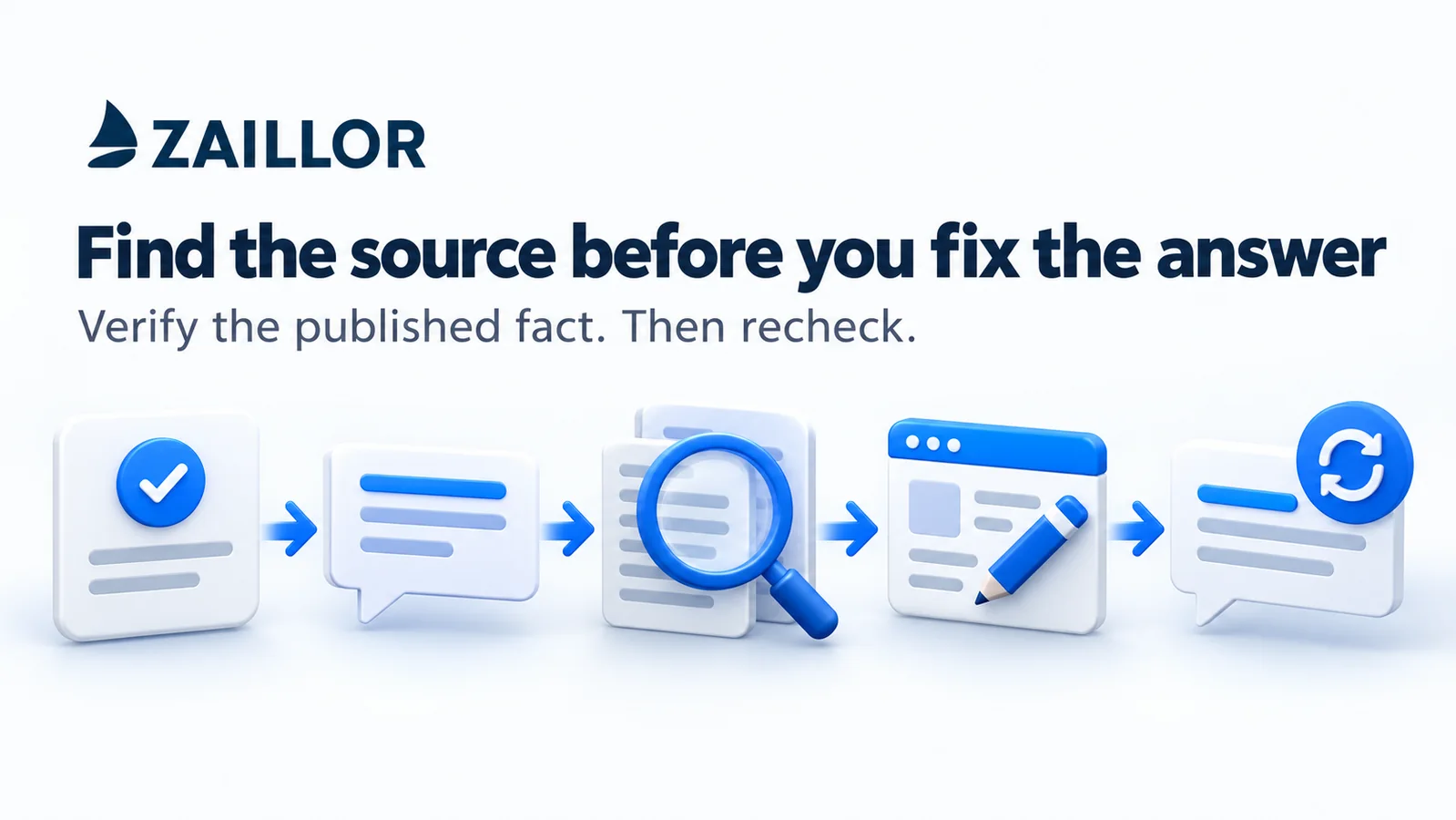
Verify the published fact, then recheck the answer.
Three mistakes that leave the investigation unfinished
Assuming a citation explains the whole answer
Inspect the sentence on the cited page. A source link can accompany an answer that interprets the page incorrectly. Report the source error only when the inspected material establishes one.
Calling a submitted edit a completed correction
An edit awaiting review has not changed the public fact. Keep the request, approval and live publication as separate statuses so the next person knows what remains unresolved.
Treating one corrected rerun as a permanent result
A prompt containing the replacement fact can influence its own answer. Retest the original buyer question and retain the conditions. Several accurate observations still describe a sample, rather than every possible future response.
Three situations that call for different actions
How to start this week
Step 1: Choose one consequential claim
Select the error most likely to change a buyer’s decision. In Zaillor’s audit-to-action approach, this means connecting a recorded claim to a business consequence and a source investigation. Assign someone to confirm the fact before deciding which page or profile to change.
Step 2: Make the smallest complete source correction
Update the relevant public information and active duplicates within your control. Use the proper external correction route where needed. Record what was changed, what remains pending and where historical context was retained. Check the live result, including any markup that repeats the fact.
Step 3: Recheck and report two separate outcomes
First report whether the source is correct and publicly available. Then repeat the original prompt in recorded conditions across planned fresh runs. Keep answers, citations and dates. “Not observed in these runs” is useful evidence. It is more precise than claiming that every future answer is fixed.
Frequently asked questions
Q: Will changing our homepage correct every AI answer?
A: No. Start where the relevant fact is published or contradicted. The homepage may be appropriate for business identity, but an address, service scope or product specification often belongs on a more specific page. External information and answer generation also need consideration.
Q: Should we add schema before correcting the text?
A: Confirm the fact and correct the visible information first. Update relevant markup as part of the same publication. Schema should describe the page accurately; it cannot make an obsolete claim true or guarantee that a platform will change its answer.
Q: What if we cannot edit the source?
A: Keep the URL and evidence, then use the publisher’s or platform’s correction process. Record requests as pending until the public information changes. Strengthen accurate information on sources you control, without claiming that this will override the inaccessible source.
Q: What if the cited page is correct?
A: Do not assume it caused the error. Check whether the answer misread context, whether another visible source conflicts or whether the claim recurs. A citation gives you something to inspect; it does not disclose the full process that produced the sentence.
Q: How long does an answer take to change?
A: There is no universal timetable. A source edit, platform review and a later answer are different events. Verify the publication first, then monitor at recorded intervals. Promise a correction process and clear reporting rather than a date by which every system will repeat the new fact.
Q: What does Zaillor do when AI gets business facts wrong?
A: Yes. The work begins by reviewing recorded answers, confirming the relevant facts and identifying actionable source discrepancies. Website, markup and eligible profile corrections can then be prioritised, with publication checks kept separate from later answer observations.
Get your free AI Visibility Score zaillor.com/get-audit
Further reading
Entity clarity and AI visibility
Structured data and AI visibility
Sources and references
Primary guidance consulted on 3 October 2026. Examples in this article illustrate decisions; they do not report measured client outcomes.
OpenAI Help Centre | Searching the web with ChatGPT |
|---|---|
Google Business Profile Help | Edit your Business Profile |
Google Search Central | General structured data guidelines |
Google Search Central | Organization structured data |