AI Search & AI Visibility
Which Five Website Pages Should a Small Business Improve First?
By Samar Pratap Singh · 13 min read
Select five pages that work together to answer important buyer questions and provide credible evidence. Page types and traffic are inputs, not selection rules.
From AI Visibility Action to Audit · Part 2 of 4
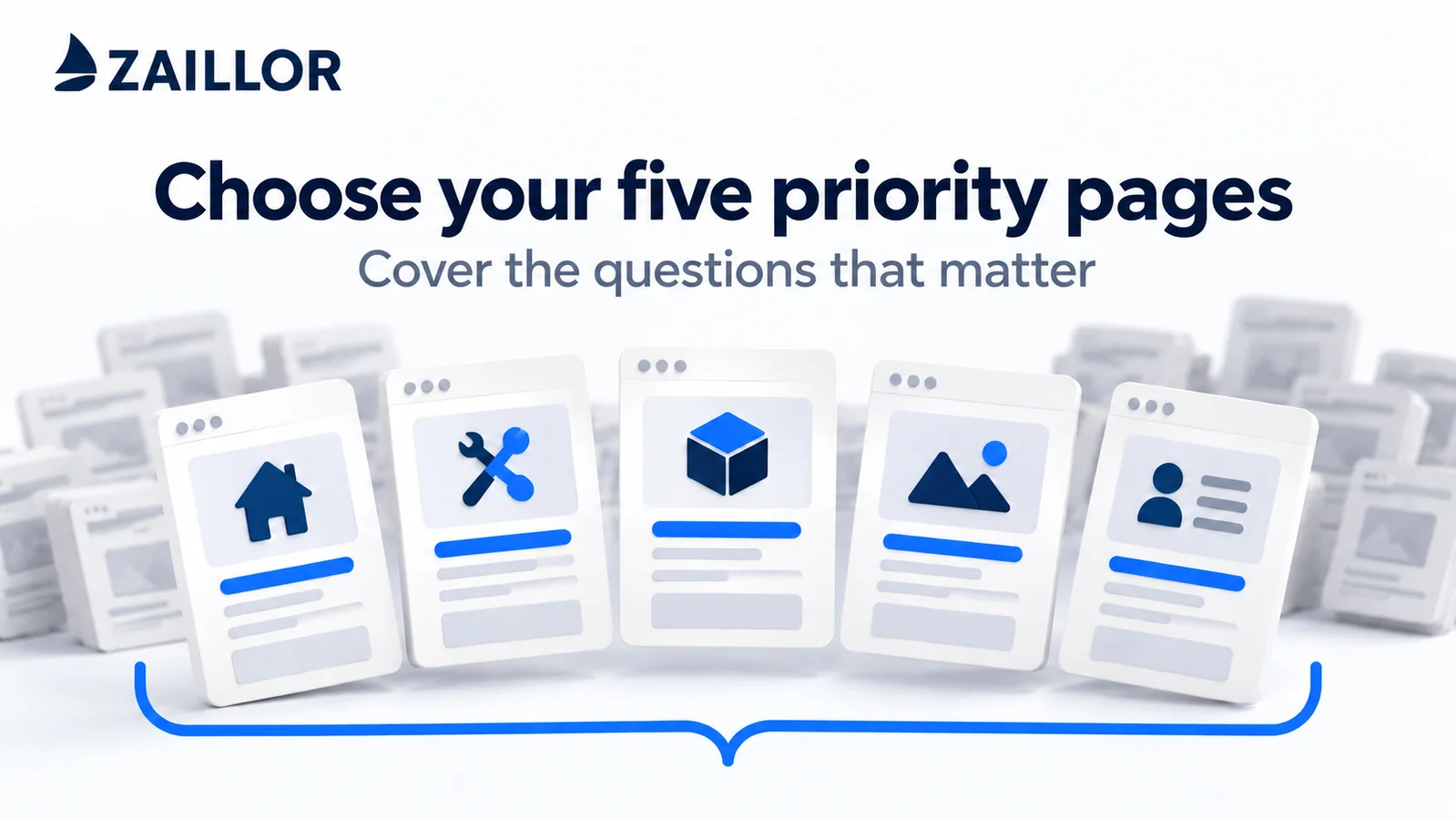
A small business can have a homepage, an About page and dozens of articles, yet no page clearly explains the service a buyer wants to compare. Choosing its five busiest URLs for improvement would miss the gap entirely.

The same happens in a catalogue. Several popular product pages may describe closely related items, while a category page that could help buyers choose between them contains little more than a grid. A shortlist based on traffic can concentrate work without improving the range of questions the website answers.
Priority page selection means choosing the existing URLs whose improvement would provide the most useful coverage of important buyer questions, business facts and supporting evidence. The question is not which five pages look most important in the navigation. It is what those pages need to establish together.
Part 1 of From AI Visibility Action to Audit explains which audit problems to fix first. This article takes the next decision: where to concentrate the page work. Five is a practical capacity limit for this exercise, not a number that AI platforms reward.
Choose the evidence before choosing the page type
Imagine showing a prospective customer around your business. You would explain what you sell, whether it fits their situation, why they should believe the important claims and what happens if they proceed. The website needs places where those answers can be found.
The building map analogy is helpful here. Your navigation is the map, the pages are rooms and the evidence is what each room contains. Selecting five rooms only because they get footfall says little about whether a visitor can complete the intended journey.
This gives the shortlist a practical job: cover the information needed for relevant decisions. A homepage may introduce the business. A product or service page may establish suitability. A verified project example may support a claim. Their roles matter more than their labels.
Google's people-first content guidance asks creators to consider usefulness, original information and whether readers can achieve their goal. Applied to page selection, the implication is to start with an actual audience need rather than a list of keywords or preferred formats. (Source: Google Search Central, Creating helpful reliable people first content.)
Start with questions a genuine buyer might ask
Write a small set of questions tied to what you can actually provide. For a sports contractor, that might include resurfacing an existing court, supplying flooring and civil work together, or working in a particular region. For an outdoor retailer, it might include choosing trekking footwear within a budget or comparing tents for a trip.
Keep the wording specific enough to expose an evidence requirement. “Best outdoor brand” raises a broad comparison question. “Two-person tent for a wet-weather trip” requires usable product details, capacity information and accurate weather-related specifications. The latter tells you more about the page work needed.
A question can matter even when the brand name is absent. That is often the point of discovery: the buyer knows the need but has not decided which supplier to consider. Assess whether the website establishes a truthful reason for your offer to fit that need.
Existing enquiries, sales conversations, onsite search and search performance can help establish relevance. Use them as inputs alongside business priorities. A target question is a working choice to monitor, rather than proof that a particular volume of customers asks it in exactly that form.
Map each question to the best existing evidence
Locate the page that should own the answer
For each question, identify the existing page best suited to answering it:
- A broad product comparison may belong on a category page.
- A precise specification belongs on the relevant product page.
- A service-scope question belongs on the service page that can explain what is included.
Avoid making every page answer every question. Repeating the same broad FAQ across several products can obscure their differences. Decide where a claim belongs, then use links from related pages to guide readers towards that source.
Identify the missing answer or unresolved fact
Read the page as a buyer. What would you still have to ask before deciding? A contractor page may need an explanation of surface preparation. A product page may need a reconciled weight specification. A software page may need to show what is generated and what the user must configure.
Give each candidate one concrete change objective. “Add an explanation of installation scope” is reviewable. “Make this page AI-friendly” leaves the writer, developer and business owner to invent different meanings.
Check that the evidence can actually be supplied
A page is a better candidate when the business can provide useful, current material: technical specifications, a photographed project, relevant expertise, delivery conditions or a clearly explained process. Selection does not create that evidence. Someone must confirm it.
If the key fact is unresolved, name the approval needed. Do not let a tight page allowance encourage unsupported copy. Another candidate may be ready to improve now, while the unresolved page remains on the shortlist with a factual dependency.
Select a set that covers different jobs
The strongest individual candidates do not necessarily form the strongest group. Three pages may all explain the same service in slightly different language. Improving all three would use most of the allowance while leaving another important buyer question unanswered.
After choosing a candidate, ask what the next page adds. It may:
- Cover another offer.
- Supply proof for an existing offer.
- Resolve identity information.
- Answer an important buying condition.
The additional coverage should be explainable without relying on the fact that the page happens to exist.
The homepage is often useful when the business category or main offer is unclear. An About page deserves attention when expertise, ownership or identity needs explaining. Neither should occupy a slot automatically if its current content already does the required job.
An existing FAQ can be improved within a service page. A contact detail can be corrected within the homepage or contact page. Five priority URLs means five selected pages, rather than five isolated sections or five new pages that must be created.
PAGE selection checklist
Compare candidates using these four questions, then review the coverage of the set. It is a public planning checklist rather than a prediction of citation probability.
An illustrative shortlist for a local service business
Consider an installer whose important enquiries concern court resurfacing, complete badminton projects and modular flooring. The following set is a worked example, not a mandatory template or a report of measured client outcomes.
Illustrative five page selection
Existing page | Job in the shortlist | Focused improvement |
|---|---|---|
Homepage | Identify the business and its main offer | State the category, core services and actual coverage clearly |
Court resurfacing service | Answer the existing surface question | Explain inspection, preparation, suitability and work included |
Badminton project service | Clarify the combined project scope | Distinguish flooring, civil work, lighting and accessories |
Modular flooring service | Support a materially different requirement | Explain intended uses, installation conditions and limitations |
Relevant project example | Support the service explanations with proof | Describe the approved scope, setting and evidence of completed work |
The About page is absent because, in this example, its facts are already adequate and the homepage introduces the entity clearly. If ownership or expertise were unclear, that decision could change. The shortlist follows the gap, rather than a universal list of page types.
A retailer would make a different choice. A category page, representative product pages and a delivery or returns page might contribute more than several service-style explanations. A small software business may need a use-case page and an output example. The selection principle stays the same; the URLs change.
Google's SEO Starter Guide explains that links help connect users and search engines with relevant pages. After improving the selected URLs, link them from appropriate navigation, category or related-content locations so the shortlist does not remain an isolated collection. (Source: Google Search Central, SEO Starter Guide.)
Give each selected page a clear change brief
A shortlist is ready for implementation when each URL has an answer to four practical questions:
- Who is the page for?
- Which question should it answer?
- What is currently missing?
- What evidence supports the proposed change?
For the resurfacing page, the brief might be to explain how an existing surface is assessed and what preparation the quote includes. It should identify the approved process information, the section to amend and the internal links that connect it to the relevant project example.
This is usually more useful than asking for a complete rewrite. Preserve accurate, distinctive material. Replace vague claims, resolve contradictions and add the explanation the buyer needs. A small addition can be sufficient when the page already performs the rest of its job.
Keep the technical check alongside that brief. Google recommends accessible text, useful internal links and structured data that agrees with page content for its AI search features. These are documented foundations, rather than evidence that a five-page programme guarantees inclusion. (Source: Google Search Central, AI features and your website.)
If structured data is part of the change, make it describe the final approved content. Google's structured data rules require representative, current information. Copying an unconfirmed specification into markup would preserve the uncertainty in a second place. (Source: Google Search Central, General structured data guidelines.)
The selection mistakes that waste a small allowance
Taking the five pages with the most traffic
Traffic can reveal useful demand, but it cannot decide commercial relevance by itself. A popular general article may attract readers unlikely to need the offer. A service page with fewer visits may answer the question that determines an enquiry.
Choosing one familiar page type for each slot
Homepage, About, service, blog and contact can be a convenient structure. It becomes a poor rule when it excludes a category page, a second distinct service or a project example needed to support the offer.
Selecting several pages with the same missing answer
Check whether those pages serve genuinely different requirements. If they do, preserve the distinctions. If they duplicate one another, resolve the page ownership question before commissioning repeated copy.
Using new blogs to replace incomplete commercial pages
A blog can explain a broader question and link to relevant offers. It should not become the only place where the business explains what its service includes. Complete the page a buyer would reasonably inspect before relying on supporting editorial content.
Three situations that change the shortlist
What you should do now
Step 1 Make a candidate list before locking five URLs
At Zaillor, we begin with relevant questions and available evidence before agreeing priority URLs. Make a broader candidate list, identify the gap on each page and note factual approvals. A large website can still have a focused first batch; selection is not the same as deciding every page needs work.
Step 2 Challenge the coverage of the proposed set
Ask what each page adds, where two pages overlap and which important question remains uncovered. Choose a set you can explain to the business owner. If only four pages have a meaningful change objective, do not manufacture a fifth rewrite to fill the allowance.
Step 3 Review the improved pages as a connected journey
Check the approved facts, readability, access and links. Then return to the original buyer questions and assess what the site can now support. Record publication dates and later monitoring results so the next shortlist reflects both remaining gaps and observed behaviour.
Frequently asked questions
Q: Does five pages mean my business only needs five pages?
A: No. It defines the focused improvement batch discussed here. Keep other useful pages available and maintain wider technical foundations. A larger catalogue or more varied offer may need subsequent batches or a broader programme.
Q: Should the homepage always be selected?
A: Select it when identity, positioning or navigation needs correction. If it already does those jobs well, another page may contribute more useful coverage. Its prominence makes it a candidate, not an automatic winner.
Q: Can one page support several monitored prompts?
A: Yes, when the questions belong to a coherent topic and the page can answer them naturally. Avoid adding unrelated sections merely to cover more prompts. Different requirements may need different pages.
Q: Should a blog be one of the five pages?
A: It can be, if it supplies relevant evidence or answers an important question better than another candidate. First check whether a product or service page needs that explanation for buyers to assess the offer.
Q: What if the best answer needs a page that does not exist?
A: Document the missing page separately. Improve existing pages where useful, and agree whether creating the new page belongs in the current scope. Do not disguise a new-page requirement as a small edit.
Q: What does Zaillor do when choosing priority URLs?
A: We relate the shortlist to approved questions, the current website and the evidence the business can provide. We define focused changes, identify dependencies and review the selected pages together before using monitoring to guide subsequent work.
Part 3 turns to factual accuracy: where to begin when an AI system gives an incorrect description of your business. The starting point will be the claim and its available sources, rather than another automatic page rewrite.
Get your free AI Visibility Score zaillor.com/get-audit
Further reading
Entity clarity and AI visibility
Sources and references
Primary guidance consulted on 2 October 2026. Examples in this article illustrate decisions; they do not report measured client outcomes.
Google Search Central | Creating helpful reliable people first content |
|---|---|
Google Search Central | SEO Starter Guide |
Google Search Central | AI features and your website |
Google Search Central | General structured data guidelines |