
A woman in Indore taps the microphone in the Google app and asks, in Hindi, which dental clinic near Vijay Nagar is open on Sunday and does root canal treatment.
She does not get ten blue links. She gets a short written answer: three clinics, their timings and links to their pages. She calls the second one.
Two streets away is a clinic with twenty years of loyal patients. Its timings sit in a photo of a signboard, and its Google Business Profile still shows last year’s Sunday hours. The answer does not mention it.
When Google writes the answer, it uses the businesses it can read, check and trust.
Why this matters for Indian businesses now
AI Mode has moved quickly in India. Google began rolling it out to everyone in India in July 2025, in English, with no Labs sign-up (Google India Blog, “AI Mode in Google Search Rolling Out in India,” 8 July 2025). In October 2025 it added seven more Indian languages to English and Hindi, and launched Search Live for voice and camera questions (Google India Blog, 8 October 2025). In April 2026 came what Google called its “biggest upgrade to shopping in AI Mode” in India (Google India Blog, 7 April 2026).
Google is now promoting AI Mode to mass audiences, from Zee TV serial storylines (Open, 30 August 2026) to an October 2026 campaign, “Samjhe. Samjhaaye. Raah dikhaye” (indiantelevision.com, 9 October 2026). This is no longer a feature for early adopters.
We have written about how AI search is changing visibility in India and why AI visibility matters for Indian small and medium businesses. This guide stays with Google’s own AI answers.
What are AI Overviews and AI Mode?
Think of the enquiry counter at a busy railway station. A passenger asks for the fastest train to Pune tonight, and the clerk answers quickly. If the passenger asks more, the clerk keeps answering, checking the timetable and notice boards first.
Now map that to Google. The quick answer is an AI Overview; the longer conversation is AI Mode. The clerk is Google’s AI model. The timetable and notice boards are Google’s index, your Business Profile and your Merchant Center feed. The link in the answer is the counter the clerk points to. Your business is one of the trains on the board.
If your train is missing from the board, or the board shows last year’s timings, the clerk does not criticise you. The clerk simply sends the passenger to another train.
In brief: AI Overviews are short AI-written summaries at the top of some Google results. AI Mode is Google’s conversational search, where people ask follow-up questions and get answers with links to the web.
What Google says about appearing in its AI answers
There is no special trick
Google says there are “no additional requirements to appear in AI Overviews or AI Mode” beyond being indexed and eligible to show a snippet (Google Search Central, “AI features and your website,” checked November 2026). Its guide for generative AI features says you do not need AI text files or special markup. The same guide adds an important eligibility detail: a site must be included in Search generative AI features in Search Console. Inclusion is the default, but owners can opt out. Good SEO is still the foundation, as we explain in our comparison of AEO, GEO and SEO.
Google runs several searches to build one answer
Google calls this query fan-out: “a set of concurrent, related queries generated by the model.” One question about a clinic may also check timings, prices and reviews. Google also recommends non-commodity content: “unique expert or experienced takes that go beyond common knowledge.”
Your Business Profile and Merchant Center count too
Google’s generative AI guide says Merchant Center feeds and Business Profiles can help products and services be “visible in both AI responses and other Google Search results.” Its AI features page asks site owners to keep both up to date and to make sure structured data matches the visible page.
Official pages are getting more space
On 15 October 2026, Google said it would test a section at the top of AI answers for tasks with “only one or two official places on the web,” and show inline links higher up more often (Google, “More ways to connect with the web from Search,” 15 October 2026). For a business, that might be its booking, order or pricing page. Google did not say whether the official-pages test runs in India.
How finding a business on Google is changing
Since January 2026, people can ask a follow-up straight from an AI Overview and continue in AI Mode (TechCrunch, 27 January 2026), and Google says it wants AI Overviews, AI Mode and traditional Search to work as one connected experience (Google, Q3 2026 CEO remarks, 28 October 2026).
For a customer looking for a business, the difference looks like this:
| Question | Classic Google search | AI Overviews and AI Mode |
|---|---|---|
| How they ask | Short typed keywords, like “dentist Indore” | Full questions, often spoken or with a photo, in English or an Indian language |
| What they see | Ten links, ads and a map | One written answer with a few linked sources |
| Who compares | The customer, across many tabs | Google, through several related searches at once |
| What gets you in | Rankings, reviews and ads | Facts in plain text, current profiles and feeds, pages in the right language |
| What happens next | The customer opens several websites | The customer contacts one of the few businesses named |
Three numbers show how many people now search this way, and how differently they ask:
| Figure | What it measures | Source |
|---|---|---|
| 1B+ | Monthly active users of AI Mode worldwide | Google, July 2026 |
| 1 in 5 | AI Mode searches worldwide that use voice, images or documents | Google, October 2026 |
| 44% | Indian internet users who engage with AI features such as voice and image search | IAMAI and Kantar via Business Today, January 2026 |
Google says AI Mode has passed 1 billion monthly active users, and its AI features send “billions of clicks to websites every week” (Google, “Q2 2026 earnings call: Remarks from our CEO,” 22 July 2026). That means AI Mode is now mainstream, and its clicks go to the sites it chooses to link.
Google also says one in five AI Mode searches globally use voice, images or documents (Google, “Q3 2026 earnings call: Remarks from our CEO,” 28 October 2026), and calls India its “largest user base for both voice and visual search globally” (Google India Blog, 8 October 2025). That means many Indian customers will speak or show rather than type, so your photos and plain answers matter more.
The IAMAI and Kantar Internet in India Report 2025 counted 958 million active internet users, 44% of them using AI features such as voice search, image search and chatbots, and more than half in rural India (Business Today, 29 January 2026). That means more people asking Google’s AI live outside big cities, and many may prefer their own language.
How Google decides which businesses appear
Google has not published the rules, but its documentation points to four questions your business needs to pass.
1. Can Google read and show your page?
Your page must be indexed and allowed to show a snippet, and your site must remain included in Search generative AI features. Search Console includes sites by default; check the setting before ruling out an eligibility problem. Make sure robots.txt, your host and your CDN do not block Googlebot. Your facts also need to be in text: Google asks for important content to be “available in textual form.” A rate card that exists only as a photo gives an AI answer little to quote.
2. Does your page answer the next question?
Because of query fan-out, one question becomes several searches. Someone asking for AC servicing in Gurugram may also want split AC prices, same-day visits and the sectors you cover. A page that answers these plainly gives Google material to use. “Best AC service in town” does not.
3. Do your business facts match everywhere?
Google says local results depend mainly on relevance, distance and how well-known a business is, and advises keeping your Business Profile “as complete as possible” (Google Business Profile Help, “Tips to improve your local ranking on Google,” checked November 2026). Its Shopping Graph covers more than 50 billion products, with 2 billion updated every hour (Google India Blog, 7 April 2026), which means a feed updated once a quarter sits beside listings that change hourly. When your website, profile and feed agree, Google has less to guess.
4. Can Google use your content in your customer’s language?
Google’s AI Mode help page lists Hindi, Bengali, Gujarati, Kannada, Malayalam, Marathi, Odia, Punjabi, Tamil, Telugu and Urdu among its supported languages (checked November 2026). Google says it uses the visible content of your page to determine its language, and recommends a separate URL for each language version, linked with hreflang (Google Search Central, “Managing multi-regional and multilingual sites,” checked November 2026). A Marathi menu bar on an English page is not a Marathi page.
Put those four questions together and you get a simple checklist.
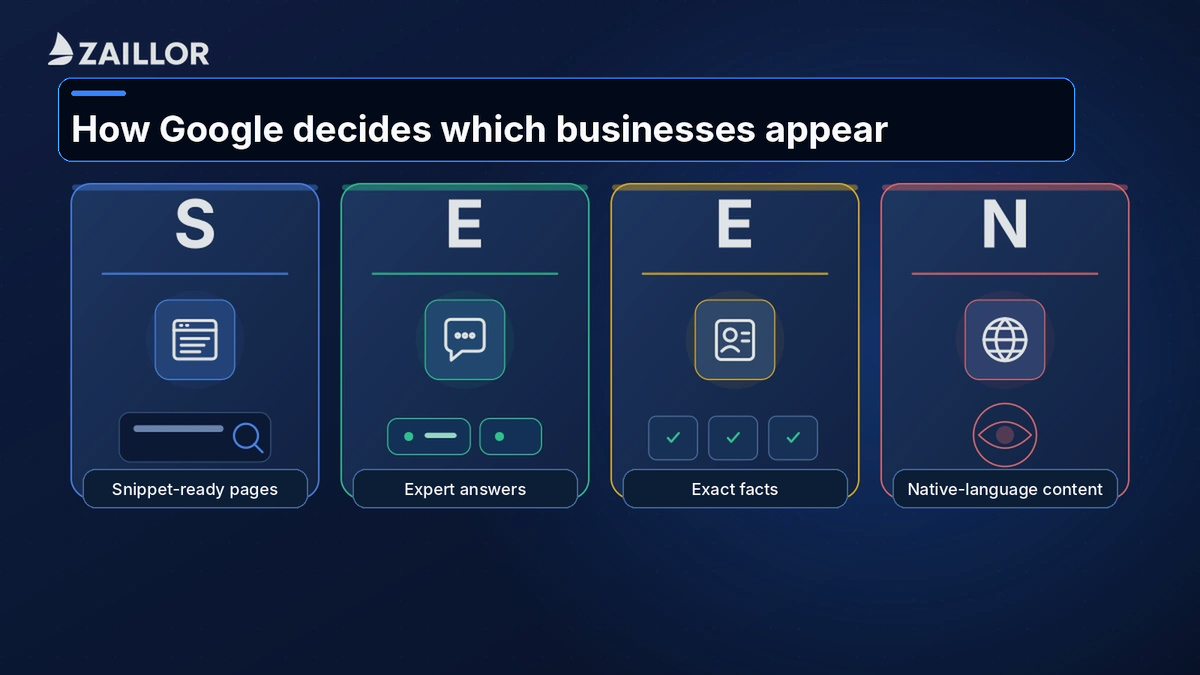
The SEEN Framework · By Zaillor
Snippet-ready · Expert answers · Exact facts · Native language
| S | E | E | N |
|---|---|---|---|
| Snippet-ready | Expert answers | Exact facts | Native language |
| Key pages are crawlable, indexed and allowed to show a snippet, with facts in text. | Pages answer follow-up questions with specific, first-hand detail. | Website, Business Profile and Merchant Center agree, and are current. | Real pages, on their own URLs, in the languages your customers use. |
To cite this framework: Zaillor (2026). The SEEN Framework for Showing Up in Google’s AI Answers. zaillor.com
How to get your business ready, step by step
This takes a day or two the first time. After that, it is a monthly habit.
- Check your key pages in Search Console. Use URL Inspection to confirm your main pages are indexed, with no stray noindex or nosnippet. Also confirm your site remains included in Search generative AI features; inclusion is the default unless an owner opts out.
- Move key facts into plain text. Write prices, menus, service areas and timings on the page, not only in images, PDFs or Instagram posts.
- Complete your Google Business Profile. Check categories, services, address, phone and hours, including festival hours. Add photos and reply to reviews.
- Keep your Merchant Center feed current. Update price and availability whenever they change, matching your product pages.
- Add pages in your customers’ language. Start with your most important page. Give it its own URL, translate the full content, and do not auto-redirect by language.
- Measure, then fix what is wrong. Search Console’s Generative AI performance report shows impressions from AI Overviews and AI Mode, including by country; Google rolled it out to all sites on 31 August 2026. Our guide to correcting what AI gets wrong about your business shows where to start.
Common mistakes that keep Indian businesses out of AI answers
1. Prices locked inside images
A photo of a rate card is easy for a customer to read on Instagram, and much harder for Google to quote.
2. A Business Profile that disagrees with the website
Different phone numbers or hours leave Google unsure which is true. It may pick the wrong one, or leave you out.
3. Translating only the menu bar
Google flags pages where only the boilerplate is translated and the main content stays in one language. Translate the content that answers the customer.
4. Blocking Google at the host without knowing
Security settings at your host or CDN can block crawlers even when robots.txt looks fine. Google asks for crawling to be allowed by any CDN or hosting infrastructure.
5. Paying for shortcuts
Google says seeking inauthentic mentions “isn’t as helpful as it might seem.” No “AI ranking” package replaces clear facts.
Three quick examples
Scenario A: The sweet shop hidden in a PDF
A Lucknow sweet shop posts its Diwali gift box prices as Instagram images and a PDF, and its Business Profile shows old hours. Asked for Diwali sweet boxes under ₹1,000 in Lucknow with home delivery, AI Mode names three other shops.
Result: Google cannot quote prices it cannot read, or trust hours that disagree.
Scenario B: The clinic that answers in Malayalam
A Kochi physiotherapy clinic publishes separate English and Malayalam pages answering cost per session, home visits and recovery time, and its Business Profile matches the website. When a patient asks AI Mode in Malayalam about home physiotherapy near Kakkanad, the clinic’s page is one of the links.
Result: A real page in your customers’ language gives Google something to use when they ask in it.
Scenario C: The furniture brand’s old delivery fee
A Jaipur furniture brand keeps its Merchant Center feed current and appears in AI Mode answers for solid wood study tables. But one AI Overview quotes a delivery fee it dropped last year, from an old blog post on its own site.
Result: Showing up is the start. Old facts travel into AI answers, so fix them where they are published.
These scenarios are illustrative examples, not real client results.
What you should do now
Step 1: See where you stand this week
Open the Generative AI performance report and group the data by country to see India. Then ask ten real customer questions in AI Mode, in English and your customers’ language, noting whether you appear and whether the facts are right. Zaillor’s AI SEO service includes prompt monitoring across ChatGPT, Gemini and Claude; the same habit works for Google.
Step 2: Fix your five most important pages
Usually these are the homepage, main service or product page, pricing, contact and one page of common questions. Our guide to the five website pages to improve first helps you choose. Update your Business Profile the same day.
Step 3: Keep your facts current every month
Each month:
- Update Business Profile hours before festivals and holidays.
- Refresh your Merchant Center feed when prices or stock change.
- Reply to new reviews, good and bad.
- Add or improve one page in your customers’ language.
If an agency handles your SEO, our checklist on whether AI SEO is actually being implemented helps you ask the right questions.
Frequently asked questions
Is Google AI Mode available in Hindi and other Indian languages?
Yes. Google’s AI Mode help page lists Hindi, Tamil, Telugu, Bengali, Marathi and several other Indian languages alongside English.
Do I need schema markup or an llms.txt file to appear in AI Overviews?
No. Google says no special schema.org markup is needed, and Google Search does not use AI text files. Structured data can still state your name, address, hours and prices clearly, as long as it matches the page. Our guide to structured data for AI visibility covers the basics.
Can I pay to appear in Google’s AI Mode?
Not in the organic answer. Google’s 28 October 2026 announcement names Australia, Canada, India, Kenya, Malaysia, New Zealand, Nigeria, Pakistan, the Philippines and Singapore as new markets for AI Mode ads (Google Ads, 28 October 2026). TechCrunch also reported the international expansion that day. Google says ads in AI-powered Search are labelled “Sponsored” and do not influence organic AI responses (Google Ads Help). Being named organically cannot be bought, the same split we describe between paying for a placement and being named in the answer for ChatGPT in India.
Will AI Overviews reduce visits to my website?
They can change which clicks you get. Google says its AI features send billions of clicks to websites every week, but those clicks can only go to the links each answer shows. If your clicks are falling, our guide to diagnosing falling clicks from AI Overviews explains what to check.
What does Zaillor do to help Indian businesses show up in Google’s AI answers?
Zaillor is an AI Visibility Optimization company. It measures how Google’s AI features, ChatGPT, Gemini and Claude describe a business, finds gaps in pages, structured data and listings, fixes them through its AI SEO services using checks like the SEEN Framework, and monitors prompts over time. It cannot guarantee a place in any AI answer, but it can make your business easier for Google’s AI to find, understand and trust.
The Bottom Line
For many Indian customers, Google’s first answer is now written, not listed. That question may come in Tamil, by voice or with a photo.
No trick gets you in. Clear, current, readable facts do. Most of this is ordinary housekeeping that many businesses skip. The businesses that do it now will be harder to replace later.
One pattern is worth watching. Google is putting AI Mode in front of people who may never have typed a long English query, through TV serials, campaigns and voice search in Indian languages. As they ask in their own language, Google will find far fewer good pages in Kannada or Odia than in English. Businesses that publish clear, current pages in those languages may face thinner competition than they have on Google in years.