AEO & AI SEO
How to optimise for Google AI Overviews when organic clicks fall
By Zaillor Team · 15 min read
Organic clicks falling? Diagnose the cause, improve Google AI Overview eligibility and useful content, and measure AI visibility separately from business outcomes.
Google SEO vs AEO Series · Part 3 of 3
Diagnose the lost click before deciding what the page needs
An organic-search report can show steady impressions and an apparently stable average position while clicks fall. The page still appears to be visible. The temptation is to blame AI Overviews, rewrite the introduction and add more schema. None of those decisions follows from the chart alone.
The missing click could reflect an answer on the results page. It could also reflect a different mix of queries, weaker demand for a valuable comparison or a technical change affecting particular URLs. The same headline pattern can require different work.
A useful response starts by locating the loss. It then asks whether the page has a verified access barrier, an unanswered buyer question or information that is useful enough to justify a visit.
Quick answer. Google AI Overview optimisation means improving a page’s eligibility and usefulness within Google’s generative search experiences, then measuring visibility separately from visits and business outcomes. It cannot guarantee inclusion or recover every lost click. Confirm the cause, preserve sound SEO foundations and make the source worth consulting beyond a brief summary.
This is a Google-specific investigation. Our guide to SEO, AEO and GEO distinctions explains the wider terminology.
The companion article on checking whether AI SEO is actually being implemented asks what work exists beyond a conventional report. Here, the question is narrower: which intervention is justified when Google clicks decline?
The results page can answer a question without completing the task
Imagine a visitor asking at a building’s information desk when an office opens. The desk can give the opening time. A visitor asking which supplier can handle a difficult project may need to enter the office, inspect examples and speak to someone.
The search results are the directory, the AI Overview is the information desk and the website contains the fuller evidence. Some questions end at the desk. Others continue. The practical job is to recognise which task your page serves and provide the information needed to complete it.
Keeping a simple answer unnecessarily hidden creates friction. Publishing only that simple answer leaves little further reason to visit. Useful depth might be a worked calculation, a product comparison with genuine limitations or an explanation of how an installation changes under different site conditions.
What Google currently requires
Google’s current optimisation guide says its generative search features rely on Search ranking and quality systems. Pages need normal indexing and snippet eligibility; no special schema, llms.txt file or artificial content chunking is required. It recommends distinctive, useful content for people. (Source: Google Search Central, generative AI optimisation guide).
Also inspect the Search generative AI control in Search Console. Its inclusion choice can affect participation in AI Overviews and AI Mode independently of other Search ranking. Confirm the setting and any inherited property choice before assuming the problem is editorial. (Source: Google Search Console Help, Search generative AI control).
These requirements define eligibility, not a promise of selection. For this Google-specific work, the additional discipline is the diagnosis and outcome measurement. A new service label does not establish that different technical requirements exist.
What click research supports and what it cannot establish
Pew Research Center analysed browsing activity from 900 US adults and 68,879 unique Google searches. Traditional-result links were clicked in 8% of visits associated with an AI summary, compared with 15% without one. Summary links were clicked in 1% of visits containing a summary. (Source: Pew Research Center, 22 July 2025).
Browsing activity covered March 2025; searches were replayed in April to inspect their results. Results could change between those observations. The study concerns a particular US sample, not an Indian business’s expected click-through rate or a controlled test of one website.
It supports investigating a change in search behaviour. It does not establish why your page lost clicks, nor that making it more citable will restore them. That requires evidence from the affected pages and queries.
Diagnose the loss at the level where it happened
Click-through rate, or CTR, is clicks divided by impressions. Compare equivalent periods for the same page and meaningful query groups, then examine country, device and search appearance. Keep commercially different queries separate. A definition query and a supplier comparison can bring very different kinds of visitor.
A diagnostic map for declining clicks
Observed pattern |
Evidence to inspect |
First decision |
|---|---|---|
Impressions steady, CTR lower |
Query mix, device, country and observed results |
Locate the declining group before editing |
Impressions and clicks lower |
Demand, indexing and query-level visibility |
Resolve access or demand explanations first |
AI visibility present, few useful visits |
What the summary answers and what the page adds |
Improve the next task the source can help complete |
Visits present, enquiries weak |
Offer fit, page usability and conversion tracking |
Investigate the visit and offer rather than chasing more citations |
Average position needs care. Google counts an AI Overview as one search position and assigns its links that position. The metric therefore cannot be treated as a clean measure of conventional blue-link rankings. (Source: Google Search Console Help, impressions position and clicks).
Record a hypothesis beside each proposed action: what do we think changed, what evidence supports that explanation and what would challenge it? A screenshot showing an AI Overview today cannot establish that it caused last month’s loss.
The query mix trap in a worked example
The following numbers are constructed solely to illustrate the arithmetic. They are not client data or research findings. Suppose a website receives definition searches and supplier-comparison searches across two equal reporting periods.
Query group |
Earlier impressions |
Earlier clicks |
Later impressions |
Later clicks |
|---|---|---|---|---|
Definitions |
8,000 |
160 |
9,000 |
180 |
Supplier comparisons |
2,000 |
200 |
1,000 |
100 |
Total |
10,000 |
360 |
10,000 |
280 |
Overall impressions are unchanged. Overall CTR falls from 3.6% to 2.8%. Yet definitions retain a 2% CTR and comparisons retain a 10% CTR. The website receives more exposure to the group with lower click propensity and less exposure to the group with higher click propensity.
Nothing in this constructed example establishes a new AI Overview effect. The first investigation concerns the lost comparison exposure: demand, visibility, competing pages or a change in the query set. Rewriting the definition pages to recover the total would address the wrong problem.
This is the query mix trap: an aggregate click decline can resemble deterioration within a page or query even when the measured CTR of each group remains unchanged. Compare like with like before choosing a content intervention.
Make the source useful for the decision after the answer
Confirm access before commissioning a rewrite
Inspect the affected URL’s indexing status, intended canonical URL and relevant access controls. Check that important information is visible and reachable through internal links. Preserve deliberate exclusions for accounts and private material. Fix a verified barrier before asking a writer to solve it with copy.
Answer the question and develop its practical consequence
State the answer clearly, then explain the conditions that change it. A flooring page may need substrate requirements, installation limitations and an approved example. A software comparison may need actual configuration differences. These details help a reader judge suitability; they are not a magic format for citations.
Google’s people-first guidance asks whether content contributes original value and leaves readers able to achieve their goal. Use those questions to identify what your page should add. (Source: Google Search Central, helpful reliable people-first content).
Our DEPTH guide to content evidence and attribution provides a broader editorial checklist. Apply it to the reader’s task rather than treating a definition or framework as a guaranteed selection signal.
Align business facts and applicable markup
A buyer needs an accurate account of the offer, its scope and who provides it. Resolve contradictions between the page, product information and active profiles. A clear answer about delivery coverage should not imply a staffed office where none exists.
Relevant structured data should describe current visible content accurately. A valid markup test verifies implementation, not future AI inclusion. (Source: Google Search Central, structured data policies).
Use the structured data guide for the wider subject, retaining Google’s explicit distinction that no special AI Overview schema is required.
For inconsistent identities and profiles, the entity clarity guide explains which public facts need reconciliation.
Use CLICK to connect diagnosis with verification
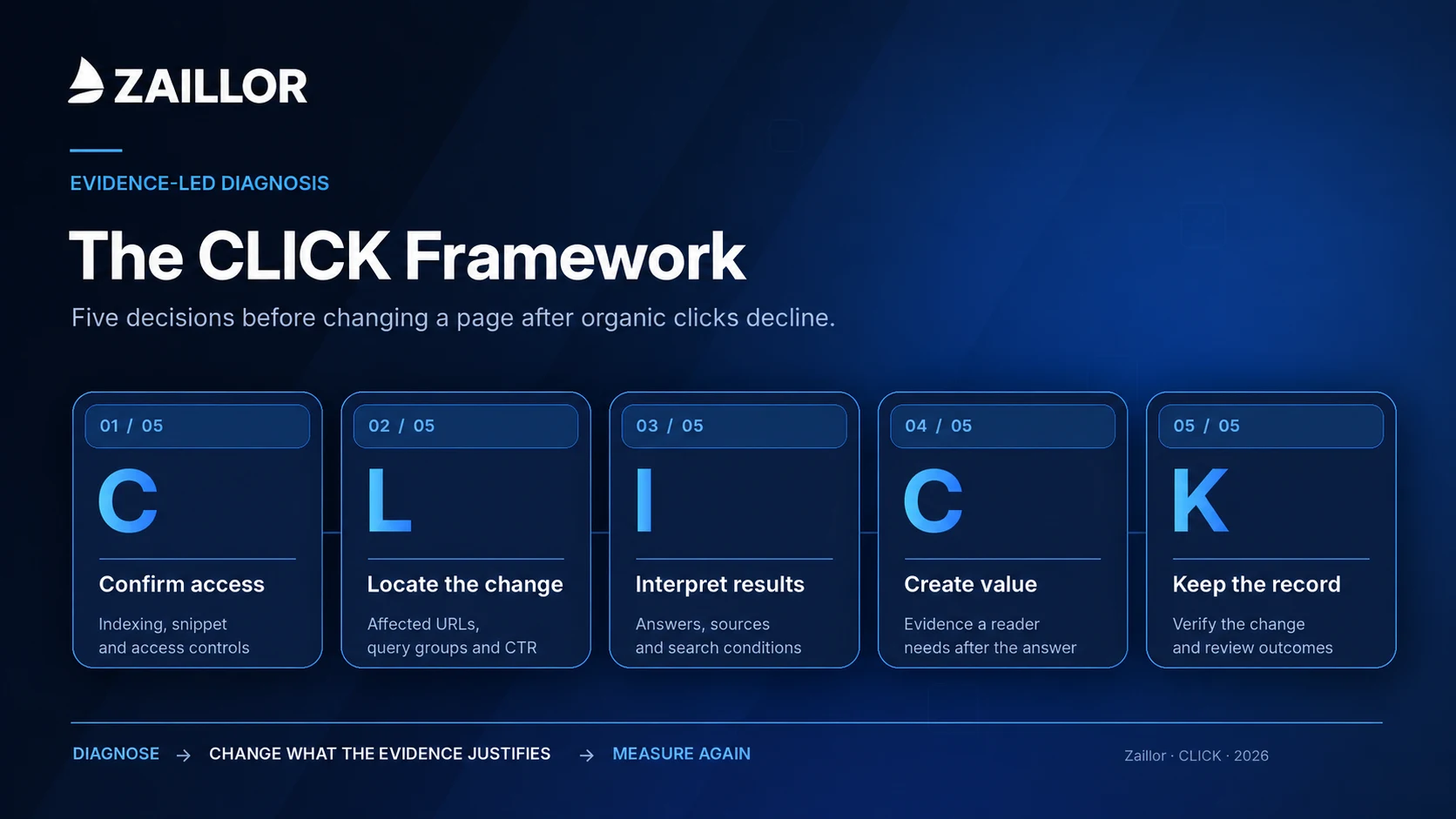
The concepts above form a practical sequence. Confirm access, locate the changing query group, interpret the observed search page, create a justified improvement and keep an outcome record. The sequence routes the work; it does not describe Google’s internal ranking formula.
The CLICK Framework
- C · Confirm access
Inspect eligibility and intended restrictions.
- L · Locate the change
Compare pages and query groups consistently.
- I · Interpret results
Save the answer, sources and conditions.
- C · Create value
Supply the evidence the reader needs next.
- K · Keep the record
Verify publication and monitor later results.
CLICK Framework for diagnosing Google AI Overview click losses. Zaillor, 2026.
Separate AI visibility evidence from traffic attribution
Current Google documentation describes a Generative AI performance report covering impressions in AI Overviews and AI Mode. It groups evidence by pages, countries, dates and devices. A property may not show the report if it lacks sufficient impressions. (Source: Google Search Console Help, Generative AI performance report).
The documented report measures exposure. It does not by itself establish which sentence was used, which query caused an individual impression or whether an AI exposure produced a sale. Read it alongside ordinary Search performance, analytics and relevant enquiry records. Its totals also involve aggregation rules, so avoid casually adding page rows into a property-wide total.
For important buyer questions, maintain a separate observation log with query wording, date, location, device, the displayed answer and visible sources. Keep these observations distinct from impression data. A recorded citation is one observation, not a complete account of everyone who saw the result.
Verify implementation first. Then compare later visibility, visits and qualified actions over a suitable period. Account for changes in demand and query composition. A short review can establish that the edit is live; it may be too early to establish sustained performance or causation.
Three mistakes that interrupt the investigation
Treating aggregate CTR as a diagnosis
The worked example shows why this can mislead. Investigate the query group that changed before assuming the entire website needs a new content strategy.
Adding markup to an unresolved fact
An old service description remains old when represented in structured data. Agree the current fact, correct visible information and align applicable markup in the same publication.
Calling an observed citation a business result
It establishes a form of visibility under recorded conditions. A useful visit or enquiry needs separate evidence. Keep the measures connected to the goal without collapsing them into one score.
Three situations that lead to different corrections
For the last situation, follow the guide to tracing inaccurate business facts to their source before selecting the edit.
Three actions to take before your next content batch
Step one Write one defensible diagnosis
Choose an affected URL with a meaningful business role. Save the comparable periods, query groups, relevant settings and observed results. Zaillor’s audit-to-action approach treats the buyer question and verification check as inputs to the work.
The guide to prioritising audit findings explains how to distinguish a blocking condition from a worthwhile improvement.
Step two Commission the smallest useful intervention
Give the owner a precise brief: the missing answer or incorrect fact, approved supporting material and the live check. Preserve useful content when one section is enough. Coordinate technical and factual changes where the evidence shows a dependency.
When capacity is limited, use the guide to choosing priority website pages to select a set that covers different buyer questions.
Step three Keep implementation and performance records
Record what changed and when it became public. Check the live source, indexing where relevant and applicable markup. Then review AI impressions, recorded answer observations, organic visits and qualified actions. Choose review dates that allow learning; do not promise recovery by an arbitrary deadline.
Frequently asked questions
Q: Can I guarantee inclusion in Google AI Overviews?
No. Eligibility and useful content are necessary considerations, but neither a checklist nor a particular page format guarantees selection. Define improvements you can verify rather than promising a placement.
Q: Does a falling CTR prove that AI Overviews caused the loss?
No. Different query proportions, devices, markets, rankings and demand can produce similar totals. Inspect comparable groups and recorded results before choosing that explanation.
Q: Is special schema or an llms.txt file required?
Google’s current guide says neither is required for its generative search features. Use appropriate structured data for its documented purposes, and assess other platforms against their own guidance.
Q: Can Search Console show AI visibility separately?
Google now documents a dedicated Generative AI performance report for impressions in AI Overviews and AI Mode. Its scope is exposure, not complete attribution from an answer to a conversion.
Q: Should I hide the answer to make people click?
No. Provide the answer, then make the source useful for the next task through evidence, conditions, comparisons or tools. Frustrating the initial question is a poor substitute for added value.
Q: How can Zaillor help with this work?
The work connects visibility observations, technical and content diagnosis, implementation and monitoring. CLICK provides a public decision aid; Google-specific checks must remain distinct from measurements on other AI platforms.
The next decision should be better supported
That changes what a useful monthly review asks. Which buyer questions have a dependable public answer? Which visits contribute to the business? Which remaining gap would the next batch actually resolve? A maintained record makes those decisions possible even when the shape of search changes.
Get your free AI Visibility Score
Sources and references
Primary guidance checked on 12 October 2026. The arithmetic and business scenarios above are illustrative, not measured client results. Each destination is linked once beside its first use.
Source |
Reference |
Date |
Destination |
|---|---|---|---|
Google Search Central |
Optimising for generative AI features |
Checked 12 Oct 2026 |
developers.google.com/search/docs/fundamentals/ai-optimization-guide |
Search Console Help |
Search generative AI control |
Checked 12 Oct 2026 |
support.google.com/webmasters/answer/16908024 |
Pew Research Center |
Google users and AI summaries |
22 July 2025 |
pewresearch.org/short-reads/2025/07/22/google-users-are-less-likely-to-click-on-links-when-an-ai-summary-appears-in-the-results/ |
Search Console Help |
Impressions position and clicks |
Checked 12 Oct 2026 |
support.google.com/webmasters/answer/7042828 |
Google Search Central |
Helpful reliable people-first content |
Checked 12 Oct 2026 |
developers.google.com/search/docs/fundamentals/creating-helpful-content |
Google Search Central |
Structured data policies |
Checked 12 Oct 2026 |
developers.google.com/search/docs/appearance/structured-data/sd-policies |
Search Console Help |
Generative AI performance report |
Checked 12 Oct 2026 |
support.google.com/webmasters/answer/16984139 |