
Short answer. ChatGPT has no published formula for recommending SaaS vendors. When it searches the web, it appears to favour products that say plainly what category they are in, that other sites mention, that answer the buyer’s question and whose facts match everywhere. For smaller vendors, other sites appear to matter most: in an October 2026 preprint on one B2B software niche, a cited third-party page naming a vendor was linked to 39.7 times higher odds that ChatGPT named it.
This is Part 2 of Show Up in AI. Part 1 gives the six-cause overview and fixes; this part covers the four signals behind ChatGPT’s picks.
How ChatGPT chooses which software to recommend
- It decides whether to search. ChatGPT “will automatically search the web if your question might benefit from information on the web” (OpenAI Help Center, ChatGPT search, checked November 2026).
- It searches through outside providers. It “may share disassociated search queries with third-party search providers such as Bing” (same page).
- It cites only what its search found. “Every page ChatGPT cites is one its own search retrieved” (University of Toronto, arXiv preprint, October 2026), and sites that block OAI-SearchBot “will not be shown in ChatGPT search answers” (OpenAI, crawler overview, checked November 2026). Part 1 covers the broader access diagnosis.
- It answers with citations. OpenAI says search answers “will contain inline citations”, listed under a Sources button, which shows the pages ChatGPT drew on.
The four signals that appear to shape ChatGPT’s SaaS recommendations
Once ChatGPT can reach your site, four signals appear to shape whether you are named. Each maps to a letter of the overview’s CLEAR check (Crawlable is covered in Part 1):
- Plain category — one plain line saying what you are and who it is for — L: Labelled.
- Outside proof — reviews, comparison articles and community threads that mention you — E: Evidenced.
- Answer-ready pages — pages for pricing, use cases, integrations and comparisons — A: Answer-ready.
- Consistent facts — the same name, plans and prices on every site — R: Reconciled.
What the October 2026 study adds
- Outside proof appears to weigh most for smaller vendors. The 39.7 odds factor came from its B2B software sample; in its consumer sample it was 4.2. The authors conclude small vendors “depend on being found by search and on third-party pages that name them”.
- Page wording mattered more than add-ons. Within a site, pages whose title and best paragraph closely matched the question were cited more often, while FAQ blocks, summary boxes and schema markup showed no significant effect.
The study is a preprint and reports associations, not causes; its B2B sample covers 55 questions in one software niche.
The diagnosis: score your SaaS on each signal
Run 8 to 10 buyer prompts in ChatGPT with web search on, twice each, because answers can change between runs. Then score each signal:
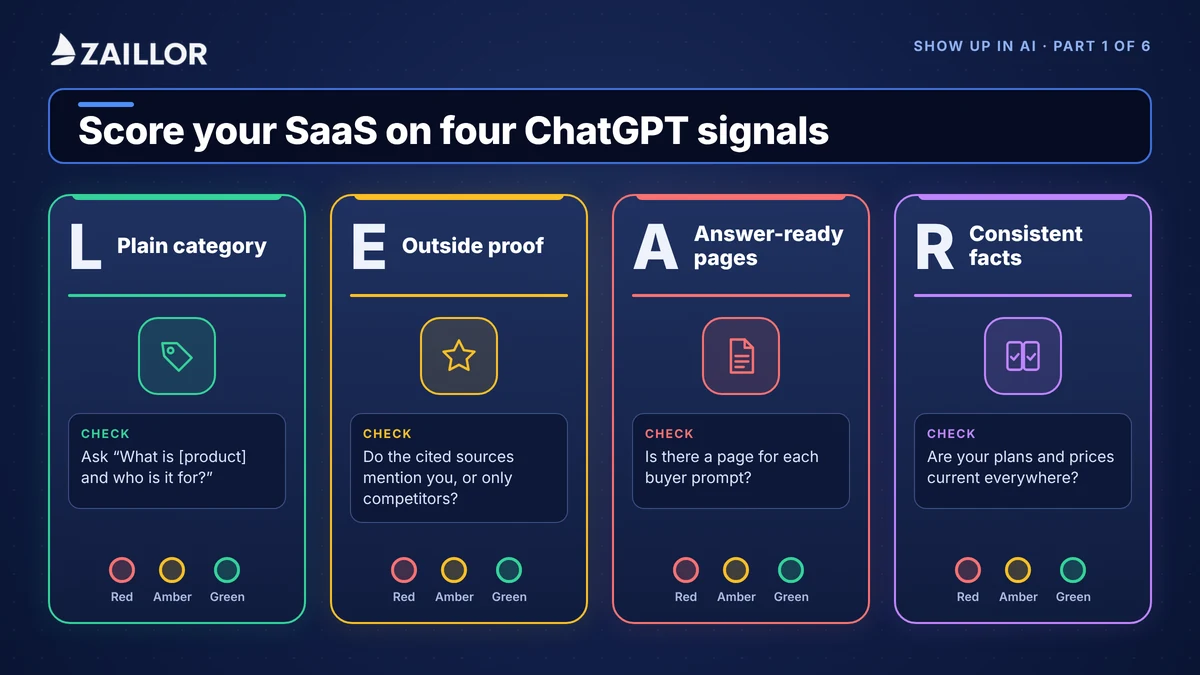
- Plain category — ask “What is [product] and who is it for?” Green: matches your homepage line. Red: wrong or vague category.
- Outside proof — open the Sources on category prompts. Green: you appear in several cited pages. Red: cited pages name only competitors.
- Answer-ready pages — find your page for each buyer prompt. Green: a page answers each one. Red: pricing or comparisons missing.
- Consistent facts — ask about your plans and prices. Green: current and correct. Red: old plans or wrong prices.
- Scoring: anything between green and red is amber. Fix any red signal first.
- Missing even for your brand name? Check access first: robots.txt, firewall rules and indexing. Part 1 gives the full diagnosis.
How to improve your SaaS visibility in ChatGPT, signal by signal
1. Plain category (L: Labelled)
- Write one line in the form “[category] for [customer]”, such as “Payroll software for Indian startups”.
- Use it in your homepage headline, title tag, About page, LinkedIn page and every listing.
- Where eligible, claim your ChatGPT business profile with the same description and category. OpenAI says this “doesn't guarantee increased visibility” (OpenAI Help Center, November 2026), so treat it as a consistency step.
- Who and when: marketing; retest after the pages are recrawled. More in the entity clarity article.
2. Outside proof (E: Evidenced)
- Start with the sources ChatGPT cited in your scorecard: get listed on those review platforms and send those article authors your current details.
- Ask current customers for honest reviews on the platforms your buyers use.
- Answer real questions in communities openly, as the company.
- Avoid fake reviews and paid posts dressed as opinion.
- Who and when: marketing and founders; expect months, not weeks. Part 6 (coming soon) audits the sources competitors are cited from.
3. Answer-ready pages (A: Answer-ready)
- Take each buyer prompt your scorecard flagged red and build the page that answers it.
- Use the buyer’s words in the page title and answer the question in one clear paragraph near the top.
- Publish a pricing page with at least a starting price.
- Add use-case, integration and honest comparison pages.
- Who and when: marketing with a developer; retest after recrawl. Start with the five pages to improve first.
4. Consistent facts (R: Reconciled)
- For each wrong answer in your scorecard, open its cited source and note the old fact.
- List every other place your name, plans and prices appear, including your ChatGPT business profile.
- Fix your own pages first, then listings and articles.
- Who and when: marketing; retest at the next monthly check. See where to start when AI gets your facts wrong.
An illustrative example, not a real client result.
Example: The category nobody could find
A Bengaluru HR software company called itself a “people experience platform”. ChatGPT named it for brand prompts but never for “HR software for Indian startups”. It rewrote its homepage line, matched every listing and asked customers for reviews.
Result: Its homepage, listings and reviews now use the words its buyers type.
Show Up in AI: where to go next
Six questions, six parts: Part 1 is the six-cause overview; Part 2 is this ChatGPT signals article. Parts 3–6 are coming soon. The series navigator lists all six topics.
Related content, outside this series: How to Get Your SaaS Recommended by Gemini.
What else people ask
Can ChatGPT recommend a SaaS without citing a page about it?
Yes. The Toronto preprint found the model’s own knowledge shapes which brands it names, sometimes with no supporting page, so newer SaaS rely more on third-party pages.
Does ChatGPT use Google or Bing results?
OpenAI names Bing as one search provider but publishes no full list, so get indexed in both. A Google ranking alone is not enough: in the Toronto study, 97% of the pages ChatGPT retrieved were absent from Google’s top 50.
Do G2 or Capterra reviews affect ChatGPT recommendations?
OpenAI has not said how it weighs reviews, but review sites are third-party pages, which the Toronto study linked strongly to vendors being named in its B2B sample.
Does ChatGPT favour big brands over startups?
No published rule says so, but known brands start ahead: in the study’s consumer sample, ChatGPT wrote a known brand into its searches in 67% of cases, against 11% otherwise. Startups need third-party coverage and clear pages.
What does Zaillor do to help SaaS companies get recommended by ChatGPT?
Zaillor is an AI Visibility Optimization company. Its AI SEO and AEO implementation services cover ChatGPT visibility for SaaS alongside schema and content. It cannot guarantee that ChatGPT will name your product.
What you should do now
- Step 1: Score your SaaS this week. Zaillor’s AI SEO service includes prompt monitoring across ChatGPT, Gemini and Claude, so the scorecard can become a monthly record.
- Step 2: Fix your weakest signal first, using the steps above.
- Step 3: Retest monthly with the same prompts.
The Bottom Line
ChatGPT has no published formula, but its citations show which pages it drew on. Four signals appear to shape whether it picks you once it can find you. For smaller SaaS, other sites tend to carry most of the proof.
Get your free AI Visibility Score. See how ChatGPT describes and recommends your SaaS.
Read next: Return to Part 1 of 6 — the six-cause diagnosis and fixes.
About the author
Ayush Gupta, Operations Manager, Zaillor. Ayush Gupta is Operations Manager at Zaillor, with four years of experience in digital marketing and SEO, covering keyword research, on-page and off-page optimisation, and website audits.
Last updated: .